Recruiters today face a growing challenge: more applications than ever before, but the same limited time to review them. For a single role, it’s not uncommon to receive hundreds, sometimes thousands of resumes.
Manually reviewing each one can take hours or even days. And despite the effort, great candidates can still be overlooked.
This is where AI resume screening is transforming the hiring process. By automating the initial screening stage, AI helps recruiters identify qualified candidates faster, reduce manual workload, and significantly shorten the hiring cycle.
What Is AI Resume Screening?
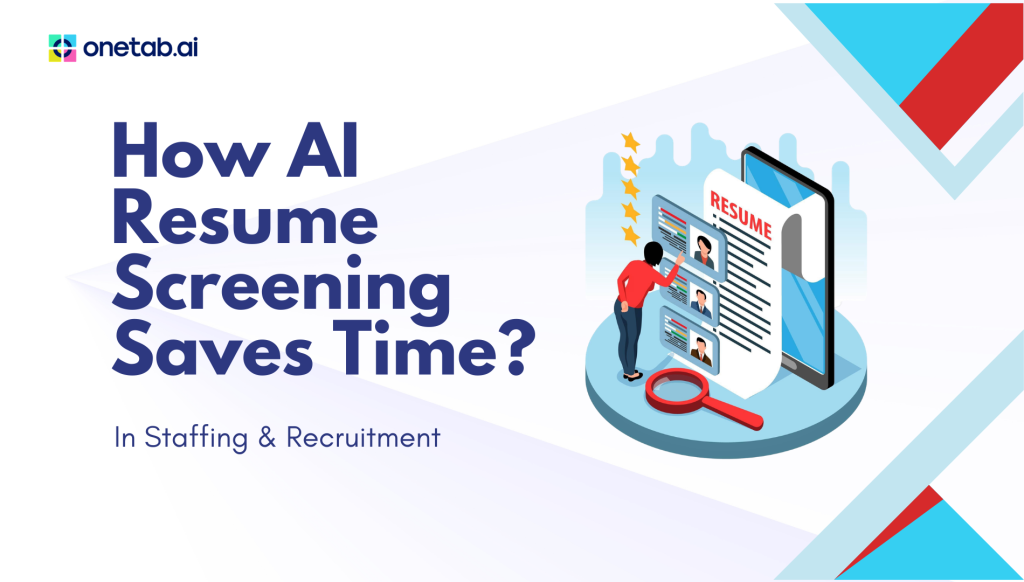
AI resume screening is the use of artificial intelligence to automatically analyze, evaluate, and rank resumes based on their relevance to a job description.
Instead of recruiters manually reading every application, AI systems can:
- Extract key information from resumes
- Compare candidate profiles with job requirements
- Rank candidates based on relevance
- Highlight top matches for recruiters to review
This allows recruiters to focus on engaging with qualified candidates rather than spending hours sorting through applications.
How Does AI Resume Screening Work?
AI resume screening tools, such as Onetab AI, use technologies such as Natural Language Processing (NLP), machine learning, and semantic analysis to understand resumes beyond simple keyword matching.
Here’s how the process typically works:
1. Resume Parsing
The AI system scans resumes and extracts structured information such as:
- Skills
- Work experience
- Education
- Certifications
- Job titles
This information is organized into a searchable candidate profile.
2. Job Description Analysis
The AI analyzes the job description to understand the role requirements, including:
- Required skills
- Preferred experience
- Industry background
- Role responsibilities
3. Semantic Matching
Instead of just matching keywords, AI evaluates the context and meaning of skills and experiences.
For example, it can understand that:
- “Customer acquisition” relates to sales and marketing
- “Data visualization” may involve tools like Tableau or Power BI
4. Candidate Ranking
The AI then ranks candidates based on how closely their profile matches the job requirements.
Recruiters receive a shortlisted list of the most relevant candidates, saving hours of manual screening.
Why Manual Resume Screening Is Time-Consuming
Before looking at the benefits of AI, it’s important to understand why manual screening takes so much time.
Recruiters typically spend 6–10 seconds scanning each resume during the initial review. While this may sound quick, reviewing hundreds of resumes quickly adds up.
Common time-consuming tasks include:
- Reading and filtering resumes
- Identifying relevant skills and experience
- Comparing candidates manually
- Managing large volumes of applications
- Updating tracking systems
For high-volume roles, this can consume a large portion of a recruiter’s day, leaving little time for candidate engagement or strategic hiring tasks.
How AI Resume Screening Saves Time
AI significantly reduces the time required for resume screening in several ways.
1. Processing Large Volumes of Applications Instantly
AI can analyze hundreds of resumes within minutes, something that would take recruiters several hours or days.
Instead of manually reviewing every application, recruiters can immediately focus on the most relevant candidates.
2. Faster Candidate Shortlisting
AI automatically ranks candidates based on job relevance.
This eliminates the need for recruiters to manually compare resumes and identify the strongest applicants. Recruiters receive a ready-made shortlist, allowing them to move directly to the next stage of hiring.
3. Reduced Administrative Work
AI tools can automatically:
- Extract resume data
- Update candidate records in the ATS
- Organize applications
- Flag top candidates
This removes repetitive administrative work and allows recruiters to spend more time on interviews, candidate engagement, and hiring decisions.
4. Improved Candidate Discovery
Traditional screening often relies heavily on exact keyword matches, which can cause strong candidates to be missed.
AI-powered screening uses semantic understanding, which helps identify candidates whose experience is relevant even if the wording differs from the job description.
This means recruiters spend less time searching for candidates and more time connecting with the right ones.
5. Shorter Time-to-Hire
When resume screening becomes faster, the entire recruitment process speeds up.
Recruiters can:
- Contact candidates sooner
- Schedule interviews faster
- Fill positions more quickly
In competitive job markets, this speed can make the difference between securing top talent and losing them to another company.
Additional Benefits of AI Resume Screening
While time savings are the biggest advantage, AI resume screening also offers several additional benefits:
- Higher recruiter productivity by reducing repetitive tasks
- Better candidate matching through deeper resume analysis
- More consistent screening criteria across applicants
- Scalable hiring processes for growing organizations
By automating the most time-consuming part of recruitment, AI enables HR teams to focus on human interactions and strategic decision-making.
How to Implement AI Resume Screening in Your Hiring Process
Adopting AI resume screening doesn’t require completely replacing your existing recruitment systems. Many organizations successfully integrate AI tools into their current hiring workflows.
Here are a few steps to get started:
1. Identify Screening Bottlenecks
Start by evaluating your current recruitment process.
Look for areas where recruiters spend the most time, such as reviewing high volumes of resumes or shortlisting candidates.
These stages are ideal candidates for AI automation.
2. Choose the Right AI Screening Tool
Select an AI solution that integrates well with your existing Applicant Tracking System (ATS) or recruitment software.
Key features to look for include:
- Resume parsing and data extraction
- Semantic candidate matching
- Candidate ranking and scoring
- Workflow integration
3. Train the System with Job Requirements
AI screening tools work best when they clearly understand your job requirements.
Provide detailed job descriptions and specify the skills, experience, and qualifications that matter most for the role.
4. Keep Human Oversight
AI should support recruiters, not replace them.
Use AI to shortlist and prioritize candidates, while recruiters make the final evaluation and hiring decisions.
This combination ensures both efficiency and quality in hiring.
5. Monitor and Improve
After implementation, continuously review the system’s performance.
Monitor metrics such as:
- Time-to-shortlist
- Time-to-hire
- Quality of candidates selected
Adjust criteria and workflows to improve results over time.
Final Thoughts
Recruitment is becoming faster, more competitive, and increasingly data-driven. Manually reviewing hundreds of resumes is no longer sustainable for many HR teams.
AI resume screening offers a practical solution by automating the most time-intensive part of recruitment. By quickly identifying the most relevant candidates, AI helps recruiters move faster, work more efficiently, and focus on building meaningful connections with talent.
For organizations looking to scale their hiring efforts, AI resume screening is quickly becoming an essential part of modern recruitment workflows.