Enterprise AI is entering a new phase.
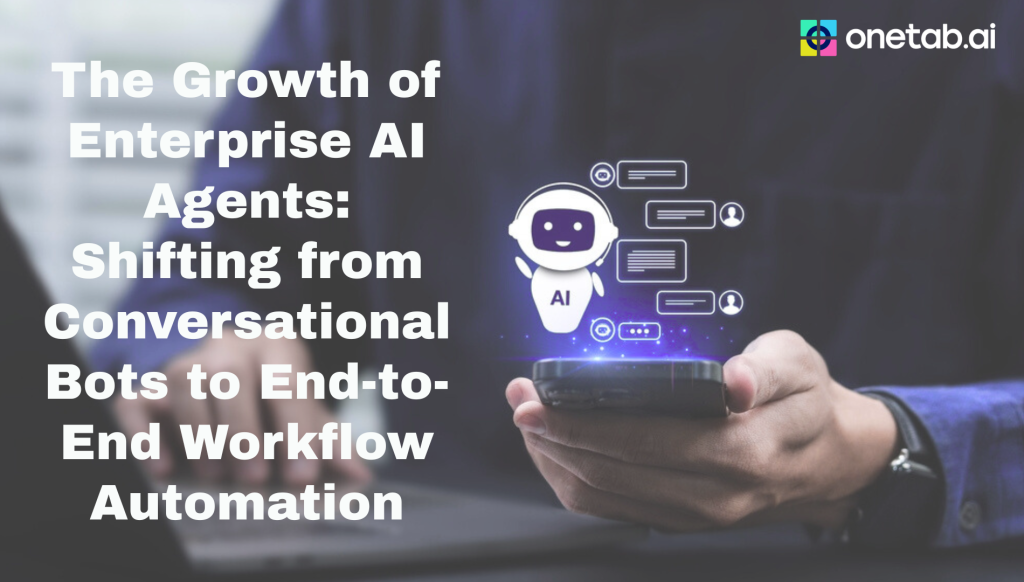
For years, organizations experimented with AI primarily through chatbots tools designed to answer FAQs, assist with support queries, or handle simple conversational tasks. While useful, these systems operated at the surface level of enterprise operations.
Today, we are witnessing the rise of Enterprise AI Agents systems that don’t just converse, but execute workflows, make decisions, orchestrate systems, and deliver measurable business outcomes.
This is not chatbot evolution.
This is operational transformation.
From Conversational AI to Action-Oriented AI
Traditional chatbots were reactive.
They waited for prompts and responded with pre-trained answers.
Enterprise AI agents are different.
They are:
- Goal-driven
- Context-aware
- Integrated with enterprise systems
- Capable of multi-step task execution
- Designed to autonomously complete workflows
Instead of saying,
“Here’s how you process an invoice,”
An AI agent actually:
- Extracts invoice data
- Validates vendor information
- Matches it with purchase orders
- Flags anomalies
- Updates ERP systems
- Routes for approval
All without manual intervention.
This marks the shift from conversation intelligence to execution intelligence.
What Defines an Enterprise AI Agent?
An enterprise-grade AI agent typically includes:
1. Workflow Orchestration
Ability to execute end-to-end business processes across systems like HRMS, CRM, ERP, ATS, and finance platforms.
2. Multi-Agent Architecture
Specialized agents working together (e.g., onboarding agent, compliance agent, document analysis agent).
3. System Integrations
Deep API-level integration with enterprise applications.
4. Decision Intelligence
AI models that evaluate context, confidence scores, and business rules before taking action.
5. Continuous Learning & Reporting
Performance analytics, workflow optimization insights, and operational dashboards.
Where Enterprise AI Agents Are Delivering Impact
HR & Recruitment
- Automated resume screening with semantic understanding
- AI voice interviews with post-call performance reports
- Candidate ranking with confidence scoring
- Automated onboarding workflows
Finance & Compliance
- Invoice validation and reconciliation
- Audit document analysis
- Policy compliance checks
- Exception flagging with risk scoring
Operations & IT
- Ticket triaging and resolution
- Access provisioning
- Multi-step approval flows
- Knowledge base automation
These are not support tools.
They are digital operators embedded within enterprise systems.
Why Enterprises Are Moving Beyond Chatbots
Chatbots reduce front-end friction.
AI agents reduce operational load.
Enterprises are prioritizing:
- Cost optimization
- Faster cycle times
- Error reduction
- Scalable workforce augmentation
- Measurable ROI
AI agents enable businesses to operate with smaller teams achieving larger outputs without sacrificing control or compliance.
The Onetab AI Approach to Enterprise Agents
At Onetab AI, we believe enterprise AI should not just assist – it should execute.
Onetab AI delivers a structured, multi-agent platform designed to integrate seamlessly with existing enterprise ecosystems. Instead of replacing systems, it enhances them with intelligent automation layers.
How Onetab AI Differentiates:
✔ Multi-agent orchestration engine
✔ Deep integration with HCM, CRM, and other systems
✔ AI-powered voice agents with performance analytics
✔ Resume semantic intelligence and candidate matching
✔ End-to-end workflow automation
✔ Confidence scoring and decision transparency
For example, in recruitment:
- The AI agent screens resumes semantically
- Conducts structured AI voice interviews
- Generates post-interview analytical reports
- Scores candidates based on strengths, confidence, and fit
- Automatically advances qualified profiles
This reduces recruiter workload by up to 60% while improving candidate quality.
In finance and compliance, Onetab AI agents analyze large volumes of documents, detect anomalies, and automate verification processes turning manual audit bottlenecks into streamlined digital workflows.
The Strategic Shift: AI as Workforce Multiplier
The future enterprise will not be defined by how many chatbots it deploys.
It will be defined by:
- How many workflows are autonomously executed
- How intelligently systems communicate
- How efficiently teams operate with AI augmentation
Enterprise AI agents are becoming digital teammates handling structured complexity so humans can focus on strategic work.
The Road Ahead
We are entering the era of:
- Autonomous workflow execution
- AI-driven operational intelligence
- Multi-agent enterprise ecosystems
The organizations that embrace AI agents today will build structural efficiency advantages tomorrow.
The rise of enterprise AI agents is not incremental innovation.
It is a fundamental shift in how work gets done.