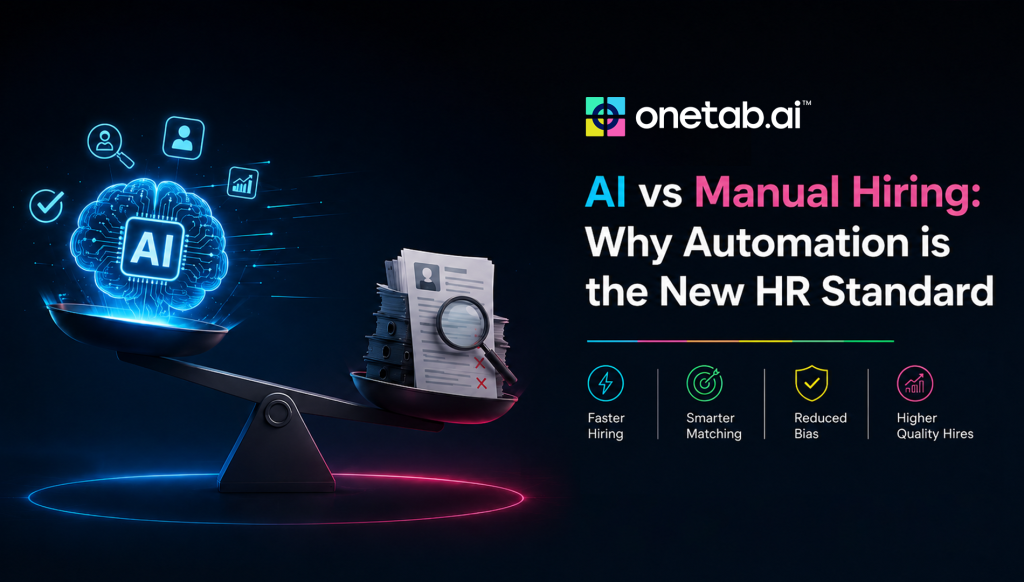
Hiring is an extremely complicated task. It requires multiple layers of documentation to go through within different companies. As businesses keep expanding, so do their markets, and this opens up new sectors for recruitment. So, the competition increases, and the need for specialised talent keeps on growing. Traditional hiring methods are not always practically viable; they require extensive manual effort, and the pace does not always match rising demands.
That is why AI has been assigned to these sectors. AI, or artificial intelligence, is capable of completing tasks efficiently with minimal delays. Most companies have already started adopting human resource software and AI tools that help in decision-making. This blog explores the differences between manual hiring and artificial intelligence-driven hiring.
Table Of Contents
- Manual Hiring: Pros, Limitations And Challenges
- AI Recruiting: The Meaning And Evolution Behind It
- How AI Transforms The Recruitment Process In HR
- AI Vs Manual Hiring: A Comprehensive Analysis
- AI-Driven HR Systems in India
- Conclusion
- FAQs
Manual Hiring: Pros, Limitations And Challenges
Physical exhaustion is a natural part of working. The human body has its limits and requires rest to maintain productivity. So even if you build the best hiring team with years of experience, manual hiring still creates a lot of obstructions. As the number of applications keeps increasing, maintaining consistency becomes difficult. You cannot realistically check 2,000 CVs or resumes within two hours. It is not physically possible, even if you have a large team. So, keeping this in mind, let us look at some of the limitations that you or your company might face:
- Excess time consumption: Recruiters spend a significant amount of time reviewing resumes, coordinating interviews, and managing communication. This slows down the overall hiring cycle, especially when multiple roles need to be filled at the same time.
- Biased choices: Manual screening often depends on subjective judgment. Even experienced recruiters may unintentionally favour certain profiles, leading to inconsistency in candidate evaluation.
- Excess documentation walkthrough: When the HR department receives numerous applications at the same time, the number can range from 15 applications to 100, even 200. Every time, maintaining quality becomes challenging. Because of this, many important profiles get overlooked, while some may get shortlisted for proper evaluation.
AI is being chosen because it processes defined parameters and delivers accurate results consistently, without being slowed down by technical limitations.
AI Recruiting: The Meaning And Evolution Behind It
This term AI stands for artificial intelligence. It is basically a powerful entity that works on data and systems designed to reduce the workload assigned to you. It completes tasks in a very short span of time, bringing out results with minimal to zero errors.
The concept of AI recruiting is the use of AI for hiring, whether it is for freshers, interns, or experienced roles in companies. Combining large-scale data scanning and machine learning helps the HR department at various stages of the recruitment process. So initially, AI had a more simplistic automation feature, but now it has moved beyond that. Today, systems are built with more advanced models where you can interact directly. This enhances the overall hiring experience. Unlike manual processes, which take time and effort, AI-enabled HR software, which is growing in India, can handle large volumes of data.
How AI Transforms The Recruitment Process In HR?
The introduction of AI into the recruitment process in HR does not mean that recruiters are getting replaced. It is added as an extension of your workload. So, it basically enhances your output and helps you to be more efficient at your job. To understand this transformation better, let us look at how AI supports hiring functionality:
- Intelligent candidate screening: When you provide a set of parameters like skills, experience, and role requirements, the AI tool filters candidates based on their resumes.
- Automated workflow management: In a manual setup, you have to schedule interviews, track candidate progress, and handle administrative tasks. With AI, and specifically with the support of Agent AI (Agent AI is an intelligent service built within an AI model that is capable of engaging in one-to-one conversations, allowing it to fulfil specific needs), most of these processes get streamlined, allowing you to focus on what actually matters rather than spending time on repetitive administrative work.
- Data-driven insights: With AI tools, you can study hiring patterns, understand what kind of candidates are being selected, and analyse behaviour trends. This helps in building better strategies and improving the overall hiring process.
AI Vs Manual Hiring: A Comprehensive Analysis
There is nothing inherently wrong with either manual hiring or AI-driven hiring. This comparison can be understood through analysing the two main aspects: speed and efficiency, accuracy and consistency. Both need to be looked at from a balanced side to understand their advantages and disadvantages.
- Speed and efficiency
AI can process large volumes of applications within seconds, while manual processes may take hours, days, or even weeks to complete the same task.
- Accuracy and consistency
Automated systems evaluate candidates based on defined data, which helps to maintain consistency. HR systems play a direct role here by ensuring that every candidate goes through the same evaluation process. Manual processes may vary depending on the recruiter’s approach. At the same time, manual hiring allows deeper evaluation through one-on-one interaction to get a better understanding of the candidate beyond just the resume.
AI-Driven HR Systems In India
The adoption of AI-powered HR software solutions in India is growing rapidly. Businesses are recognising the value of integrated systems that combine all the elements of recruitment, onboarding, and workforce management. For every HR recruiter, this means having access to a single connected system that handles multiple functions without switching between platforms. Platforms like Onetab.AI are enabling organisations to manage their entire HR lifecycle through a single system. From candidate screening to onboarding workflows, such solutions bring together multiple functions in a connected environment.
Unlike manual processes, AI-enabled HR software India solutions are designed to handle large volumes of data efficiently. They analyse candidate information, identify patterns, and support recruiters in making more informed choices. This approach not only reduces operational challenges but also ensures that hiring decisions are backed by data rather than assumptions.
Conclusion
We have to accept that AI is indeed responsible for simplifying hectic tasks, no matter the sector. The faster we accept it, the better it is. As the need for hiring continues to expand, the hiring demand continues to grow; companies and organisations would need solutions that can match their needs.
The integration of AI in recruitment, supported by intelligent human resource software like Onetab.AI, brings together speed, structural integrity and consistent results to the recruitment process. Over time, this transition helps organisations build a strong hiring framework.
FAQs
Q1. How is AI recruiting different from manual hiring?
AI recruiting uses two key components: automations and data analysis to evaluate suitable candidates, who will work responsibly for the job role.
Q2. Can AI replace HR recruiters completely?
AI is not required to replace recruiters. AI tools act as an extension to simplify the workload.
Q3. Why are HR systems important for modern organisations?
HR systems are responsible for streamlining the hiring processes, improving efficiency, and providing better control over workforce management.
Q4. Can AI recruiting be suitable for small businesses?
AI recruiting is not applicable only to large companies. Even small to medium-sized businesses can use these tools to manage applications.
Q5. What kind of data does AI use to look through the candidate’s resume?
The AI tools work with resume data, skills, experience levels, and role requirements. Based on the parameters you set, it filters and shortlists candidates that match the criteria you have defined.
References
- X0PA AI. (2026). AI in recruitment: How artificial intelligence is transforming hiring processes. Retrieved from https://www.x0pa.com
- TurboHire. (n.d.). Recruitment automation: How AI simplifies hiring workflows. Retrieved from https://www.turbohire.co
- Phenom. (2022). The benefits of AI in hiring and talent acquisition. Retrieved from https://www.phenom.com
- Peerbits. (n.d.). AI-powered resume screening and candidate evaluation. Retrieved from https://www.peerbits.com
- Onetab AI. (n.d.). HR solutions, automation, and workforce management platform. Retrieved from https://www.onetab.ai
 Kashish Rugwani
 Pratish Gopinath