
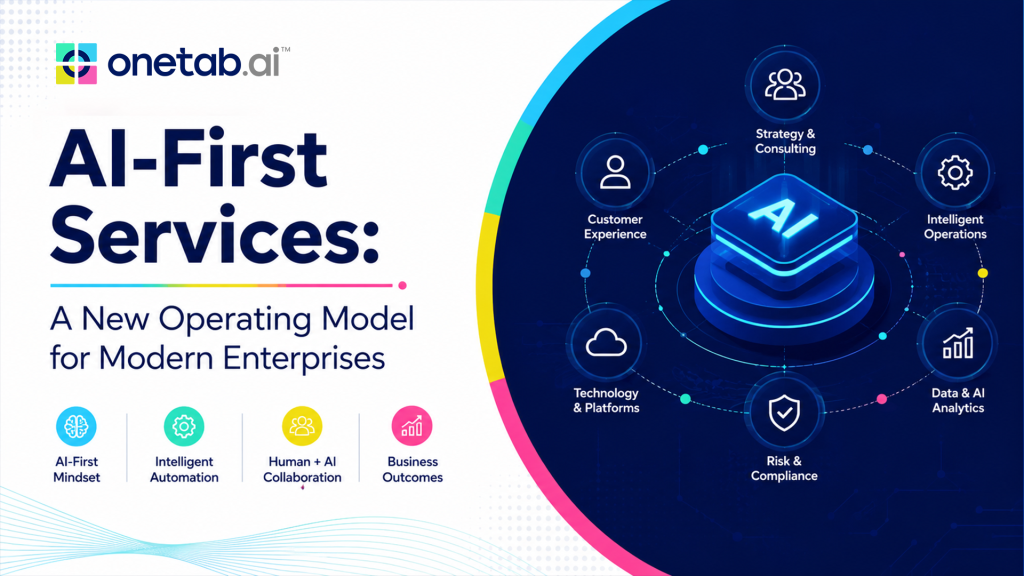
AI-first services are not simply existing services with a chatbot added to the front. They represent a shift in how work is designed, delivered, measured, and governed. In an AI-first operating model, teams ask a different question: if an agent AI can search, summarise, coordinate, and prepare actions across systems, how should the service itself change?
For modern enterprises, this matters because many service functions are under pressure to move faster without adding more manual coordination. Sales operations, customer support, HR, IT, finance, marketing, and internal operations all depend on knowledge spread across AI business tools. AI-first services use agents and automation to reduce that fragmentation while keeping humans responsible for judgment and oversight.
Table of Contents:
- Understanding AI-First Services
- The Shift From Tools To Workflows
- Components Of An AI-First Operating Model
- AI-First Services Across The Enterprise
- Governance Is Part Of The Service
- Why Enterprises Need A Phased Rollout
- Role of OneTab.AI In AI-First Services
- A Practical AI-First Service Design Process
- What to Measure
- Conlusion
- FAQs
Understanding AI-First Services
An AI-first service is designed around human-AI collaboration from the beginning. The service workflow defines what an agent AI can do, what data it can access, what decisions require review, and how the outcome is measured. The agent AI is not an optional add-on. It becomes part of the service delivery model.
This does not mean every action is autonomous. In mature AI-first services, the artificial agent often prepares the work and humans approve, refine, or handle exceptions. The operating model changes because humans spend less time searching and reformatting information, and more time making decisions.
The Shift From Tools To Workflows
Many enterprises have too many disconnected AI business tools. Each department buys software for a specific function, then teams rely on people to bridge the gaps. A customer issue may touch a helpdesk, CRM, order system, email thread, policy doc, and Slack channel. An employee onboarding request may touch HRIS, IT tickets, calendar invites, docs, and finance approvals.
AI-first services focus on the workflow that crosses those tools. The agent AI gathers context, checks the SOP, prepares the next action, and creates a traceable handoff. The service is measured by the outcome, not by how many apps were opened.
Components Of An AI-First Operating Model
| Component | Why it matters |
|---|---|
| Clear service goals | Agents need measurable objectives, not vague productivity mandates |
| Connected knowledge | Data, docs, and records must be searchable and permissioned |
| SOP-aware workflows | Agents need rules for what to do, when to stop, and how to escalate |
| Human approval | High-impact actions need review and accountability |
| Logs and reporting | Teams need visibility into what the artificial agent read, changed, and recommended |
| Continuous improvement | Workflows should be evaluated and adjusted after real use |
These components make AI-first services operational rather than experimental.
AI-First Services Across The Enterprise
In customer support, an AI-first service may gather account history, identify the likely issue, draft a response, and escalate with a clean summary. In sales, it may prepare account research, update CRM fields, draft follow-ups, and surface risks. In HR, it may answer employee questions from approved policy docs and trigger onboarding tasks. In IT, it may triage requests, check access requirements, and prepare approval workflows.
The common pattern is not “replace the team.” It reduces the repetitive coordination that slows the team down.
Governance Is Part Of The Service
AI-first services need governance built into the workflow. That includes access controls, approval thresholds, logs, evaluation criteria, and fallback paths. Without these controls, agents may create risk by acting on incomplete data or taking actions that should require human review.
Good governance starts with a scope definition. What can the agent AI read? What can it write? Which systems are off limits? Which actions require approval? What should the artificial agent do when confidence is low? These answers should be documented before deployment.
Why Enterprises Need A Phased Rollout
AI-first services work best when introduced in narrow slices. Start with one service line or one workflow where the process is understood and the data sources are accessible. Measure the baseline, pilot the agent-assisted process, review logs, and expand only after the workflow is reliable.
A phased rollout also helps teams build trust. Employees need to see how the agent AI works, where it stops, and how they can correct it. Leaders need metrics that show whether the service improved. IT and compliance teams need proof that permissions and logs are functioning.
Role of OneTab.AI In AI-First Services
OneTab.AI is relevant to AI-first services because its public positioning focuses on agents that learn from company data, processes, and SOPs, then automate work across existing AI business tools. Its site describes a connected surface for email, CRM, spreadsheets, helpdesk, docs, calendar, chat, and issue trackers, with agents that plan, act, verify, and report.
For enterprises redesigning services, this type of platform can support the operating model by connecting fragmented context to action. A team can start with one workflow, define permissions, encode SOPs, and review the agent’s output before expanding. Teams should confirm current integrations, security controls, and setup requirements for their environment before rollout.
A Practical AI-First Service Design Process
Begin with the service outcome. For example, “reduce support handoff time” is more useful than “use AI in support.” Map the current workflow and identify where people spend time gathering information, updating tools, or waiting for approvals. Then define the agent’s role in that workflow.
Next, prepare the knowledge layer. The agent needs reliable documents, records, and tool access. Remove outdated policies, clarify ownership, and decide which sources should be authoritative.
Finally, set the control model. Decide which actions are automatic, which are approval-ready drafts, and which should remain human-only. This is where AI-first services become enterprise-ready.
What To Measure
AI-first service metrics should include cycle time, backlog age, handoff count, response quality, update accuracy, employee review time, exception rate, and customer or stakeholder satisfaction. Teams should also track how often the agent asks for clarification and how often humans correct its work.
These measures prevent AI-first services from becoming a vague transformation project. They keep the focus on better operations.
Conclusion
AI-first services are changing the way businesses operate by redesigning workflows around collaboration between people and AI, rather than simply adding automation to existing processes. When supported by connected data, clear governance, and well-defined human oversight, they can reduce repetitive work, improve service quality, and help teams focus on higher-value decisions.
The key is to start with a specific business problem, build around a well-understood workflow, and scale gradually based on measurable outcomes. As enterprises continue to modernise their operations, AI-first services offer a practical path toward more efficient, consistent, and intelligent service delivery—without losing the human judgment that remains essential to business success.
FAQs
Q1. Is an AI-first service fully autonomous?
Not necessarily. Most enterprise services should combine agent assistance with human oversight, especially for sensitive actions.
Q2. What is the biggest blocker?
The biggest blocker is often fragmented or unreliable knowledge. Agents need clear sources, permissions, and SOPs.
Q3. How should enterprises start?
Start with one bounded workflow, measure the current baseline, pilot agent support, and expand only after reviewing results.
 Kashish Rugwani
 Pratish Gopinath
 Saket Dandotia