
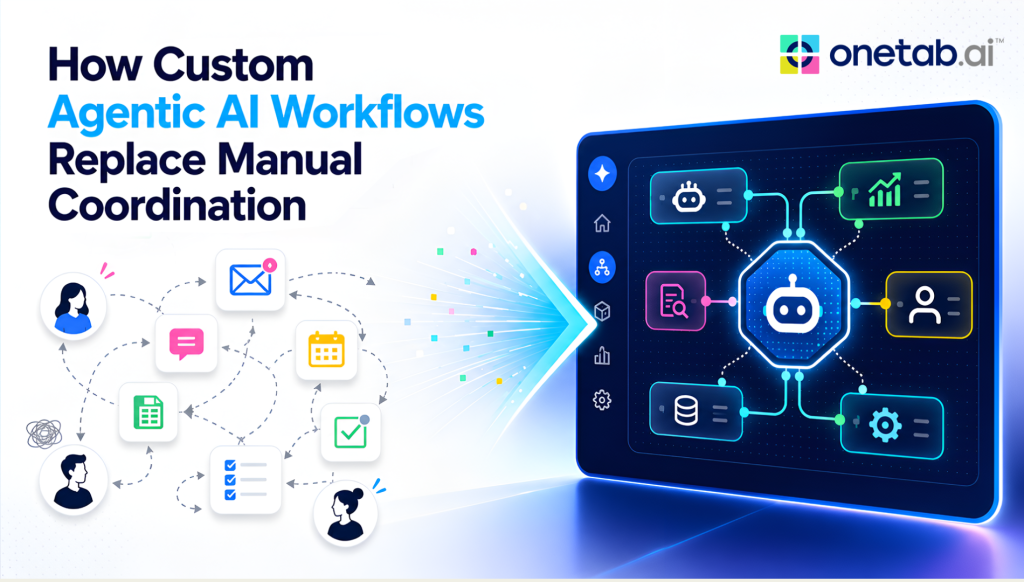
For around decades, organisations have been dependent on manual workflows to maintain efficient operations, approvals via emails, spreadsheets updated manually and repetitive tasks performed step-by-step by different human teams. Such systems worked well during the times when speed was optional, and the scale was easily manageable. However, since the invention of AI for enterprise, we no longer exist in the same era.
At present, operating business environments demand continuous execution, real-time decisions, and the ability to manage scales without any increases in headcount or cost. This is where an autonomous AI of an artificial intelligence agency comes into the picture.
Unlike traditional AI-powered tools that needed instructions, agent AI systems act, plan, and adapt independently. They do not simply assist workflows, but function them; the results show a fundamental shift in the way the work is done, transforming from human-driven procedures to intelligent, autonomous execution. The AI agentic represents another wave of automation. They showcase the redesign of workflows to another level. In this blog, we will discuss how custom agent AI workflows replace manual coordination.
Table of contents:
- Introduction
- Agentic AI and Agentic Workflows
- Drawbacks Of Manual Workflows Across Industries
- How Custom Agent AI Workflows Replace Manual Coordination
- Use Cases Of AI Agent Workflows
- Conclusion
- FAQs
Agentic AI and Agentic Workflows
Agent AI defines an intelligent system designed to function with a higher level of autonomy. Such systems pursue objectives actively, make informed decisions and fulfil tasks across multiple procedures and systems instead of simply depending on the defined scripts or prompts. At its core, agent AI can:
- Interpret higher-level objectives
- Divide them into actionable steps
- Execute these steps across environments and AI-powered tools
- Monitor results and approaches in real-time
This is what differentiates agent AI fundamentally from a traditional artificial intelligence tool and agency. Traditional automation depends on a set of strictly followed, fixed instructions and predefined rules. This aligns with repeatable, predictable tasks; however, it fails when uncertainty arises or conditions change. In contrast, agent AI brings forward decision-making within the loop. It evaluates context, selects between different possible actions, and adapts when fresh information is available. Rather than rigid workflows, agent AI gives dynamic execution.
Moreover, AI for enterprise includes outcome-driven procedures performed by AI agentic. Rather than prescribing, each micro staff team defines the boundaries, objectives and success metrics. Later, the agent chooses and sequences the required actions to fulfil that goal by navigating multiple disparate systems. Some common agent AI workflows consist of:
- Defining goals: Establishing the constraints, objectives and success parameters.
- Planning: Artificial intelligence decomposes the goal into a different sequence of tasks along with logical dependencies.
- Execution: The agent brings together all the best AI tools for business, requiring databases, interacting with the API or browsing the web.
- Evaluation: Verifying outputs against safety policies, internal rules, or success metrics.
- Iteration: When the results aren’t up to the mark, the agent refines the entire plan and follows a different approach.
Drawbacks Of Manual Workflows Across Industries
Manual workflows across businesses were developed for an operating environment where systems were isolated, volume was predictable, and delays were tolerated. In today’s digital operations, such assumptions no longer exist. As processes are becoming highly time-sensitive and interconnected, the limitations of human-centred process execution become more costly and visible.
- Speed limitations
Humans perform tasks sequentially. Even some of the most highly efficient teams experience certain constraints regarding availability, attention, and working hours. However, modern working systems need parallel quantities, execution across platforms, and time zones. This develops a fundamental mass between the people who produce work and how quickly the results are expected.
- Probability of errors
Repetitive manual work comes with variability. Context switching, fatigue and inconsistent judgment result in small errors, which are hard to detect early. When working at scale, such small deviations collect into operational inefficiencies, revised cycles, and compliance risks that eventually slow down everything.
- Scalability cost
Scaling manual tasks includes adding more coordination, layers, personnel, and management overhead. This approach eventually enhances cost, along with introducing added complexity. On the other hand, demand rises nonlinearly, creating a gap between capacity and workload.
How Custom Agent AI Workflows Replace Manual Coordination
Agentic AI can replace manual workflows by converting execution from human-driven step chains into goal-driven, autonomous systems. Rather than breaking down work into rigid tasks assigned to different people, the system implements the objective and then executes the complete workflow automation through different coordinated agent actions. This changes the structure and speed of all operations.
- Autonomous execution of tasks
An AI agentic can execute the entire workflow automation end-to-end without planning or needing any step-by-step intervention from humans. They interpret requirements, ingest input, and perform the process completely using connected services and AI-powered tools. For instance, for invoice processing, an AI agent is capable of extracting data, validating entries, matching purchase orders, and triggering payment workflows without any manual intervention at any of the stages.
- Constant decision-making
Rather than depending on a step-by-step approval cycle, agent AI systems can evaluate situations in real-time and perform immediate decision-making within specific boundaries. This lowers operational friction that is caused by handoff from different departments and administrative queues. By implementing decision logic into the loop, automation workflows can continue working without interruptions and escalate to human intervention only when policy constraints or risk thresholds are triggered.
- Self optimization
Agent AI systems can achieve continuous self-optimisation by integrating iterative feedback loops. By analysing performance results systematically and identifying the friction of operations, such systems refine their execution strategies in real-time, prompting logic, optimising tool selection, and decision pathways. Unlike traditional procedures, the efficiency that agent workflows offer evolves dynamically through constant learning and execution.
- Cross-system integration
Agents stand as a link across some of the best AI tools for business, systems, and data sources. Creating direct integrations removes the friction of manual transfer of data between CRM, spreadsheets, databases, and ticketing platforms. With this capacity, agent AI stands as an intelligent coordination layer. Retrieves updates and information independently across different environments, ensuring data consistency continuously, along with reducing the risk of duplication errors, which are often common in human-driven workflows.
Use Cases Of AI Agent Workflows
Agent AI workflows are created to step beyond static automation by making systems plan, adapt, and perform tasks with a higher degree of autonomy. Such workflows are valuable in environments where operational tasks are multi-step, dynamic, and need contextual decision-making. Some of the impactful agent AI use cases include:
- Intelligent customer support automation
- Autonomous data and research analysis
- Workflow automation & orchestration in different business operations
- Personalised content generation
- Software development assistance
- Decision support and financial monitoring
- Healthcare support and coordination
- Logistics optimisation and supply chain
- Cyber security response and monitoring
- Adaptive and educational learning systems
Conclusion
The transformation from manual workflows to agentic AI automation is not only a technological upgrade, but also an update from task execution to automated outcome-driven systems. AI agents minimise delays, enable scalability, continuous operations, and eliminate repetitive effort. Its true impact lies in letting teams focus less on handling processes and more on enhancing results. The direction with AI agent automation is clear. Workflows are becoming highly adaptive and autonomous. Organisations implementing such changes with proper control and structure will achieve sustainable operational benefits.
With Onetab.AI AI agentic workflows, your organisations can step beyond traditional automations by deploying and building workflow automation builders personalised to your unique operational needs. We focus on reducing manual effort across decision-heavy and repetitive workflows through end-to-end, intelligent automation. From system integration and process analysis to decision-making, we help businesses redesign the way work is done. The results come with improved accuracy, better execution, and scalable operations adapting to changing requirements. Hence, with Onetab.AI’s AI automation services, organisations transition from fragmented, manual workflows to outcome-driven, scalable systems powered by our unique agent AI.
FAQs
Q1. How can AI agents replace manual coordination?
AI agents get to replace coordination by monitoring events, delegating tasks, interpreting context and orchestrating workflow continuously in real-time. This further reduces the demand for approvals, meetings and follow-ups, letting AI agents replace manual coordination to operate more consistently and faster than humans.
Q2. How are AI agents better than human coordinators?
AI agents are outperforming humans as they operate and handle vast amounts of data instantly, without fatigue and coordinate across different systems simultaneously. This promotes real-time coordination and constant execution, which human teams fail to sustain.
Q3. Are AI agents capable of managing complex enterprise workflows?
Yes, AI agents are suitable for enterprise operations as they are designed specifically to manage cross-department, multi-step workflows via multi-agent systems. These agents coordinate, execute, plan, monitor and handle tasks autonomously.
References:
- Hyland. (n.d.). Agentic AI automation: Transforming business processes with intelligent agents. Hyland. https://www.hyland.com/en/resources/articles/agentic-ai-automation
- GitLab. (2025, February 25). 8 agentic AI patterns reshaping team collaboration. GitLab Blog. https://about.gitlab.com/blog/8-agentic-ai-patterns-reshaping-team-collaboration/
- AI Business Optimization. (2026, January 19). Agentic AI for cross-team coordination. AI Business Optimization. https://aibusinessoptimization.com/blog/2026-ai-practical-agentic-ai-37-agentic-ai-for-cross-team-coordination
 Onetab
 Yashita Maltare
 Kashish Rugwani