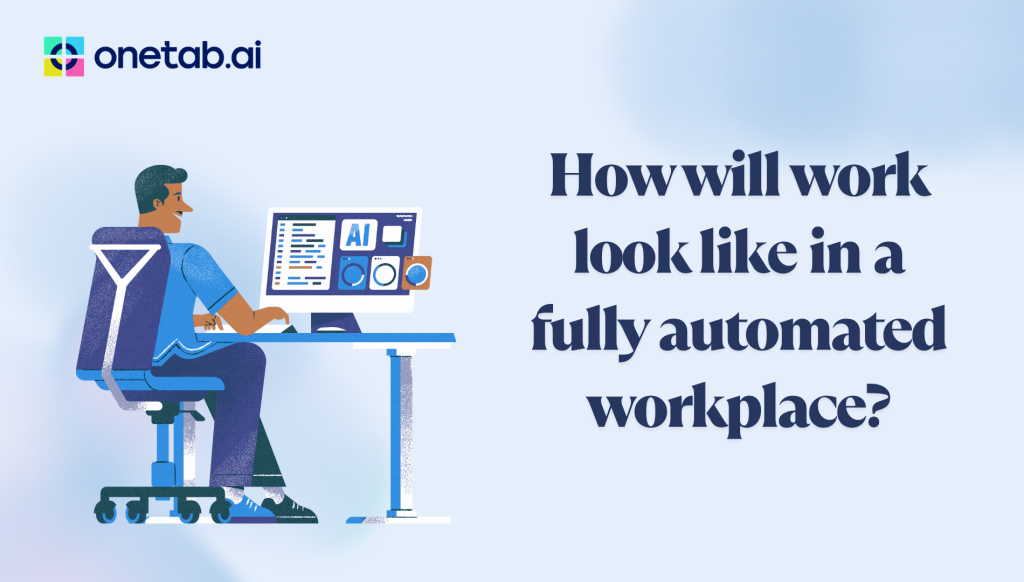
Imagine walking into work… and you don’t have to start your day wondering where to begin. The system already shows you where you left off, what’s been handled, what’s in progress, and what actually needs you.
No cluttered inbox. No chasing updates. No back-and-forth for basic approvals. Just clarity, momentum, and a quiet system in the background that already knows what needs to happen.
This isn’t some far-off future. It’s what a fully automated workplace is starting to look like today. Let’s walk through the day.
9:00 AM – You Start, But the Work Already Has
You log in, and instead of a flood of emails, you see a clean, prioritized dashboard.
Overnight:
- Leads were captured, enriched, and scored
- Support tickets were categorized and responded to
- Reports were generated and shared with stakeholders
- Candidate pipelines were updated, screened, and ranked
No one stayed up doing this. The system did. You’re not starting from zero. You’re stepping into progress.
10:30 AM – Decisions, Not Data Gathering
Instead of spending your morning pulling data from five different tools, everything is already compiled. You ask a simple question: “Which deals are at risk this week?”
And you get:
- A clear list of accounts
- Risk signals (low engagement, delayed responses)
- Suggested actions
No digging. No spreadsheets. Just decisions. This is the shift: from finding information to using it.
12:00 PM – Meetings That Actually Matter
Meetings are fewer, shorter, and sharper.
Why? Because:
- Status updates are automated
- Notes are captured in real time
- Action items are assigned automatically
No one is asking, “Can you send me that later?” It’s already done.
You’re not meeting to sync. You’re meeting to solve.
2:00 PM – Execution Without Friction
You need to launch a campaign.
Instead of coordinating across teams, you just define the intent: “Launch a campaign targeting mid-sized SaaS companies with a focus on cost efficiency.”
The system:
- Drafts messaging
- Segments the audience
- Schedules outreach
- Tracks performance in real time
You review, tweak, approve. What used to take days now takes minutes.
3:30 PM – Hiring Without Bottlenecks
A new role opens up.
Traditionally, this would mean:
- Screening hundreds of resumes
- Coordinating interviews
- Evaluating candidates inconsistently
Now:
- Candidates are auto-sourced and screened
- Technical evaluations are handled instantly
- Only top-fit profiles reach human review
Recruiters don’t lose control. They gain focus. They spend time on conversations, not filtering.
5:00 PM – Work That Feels… Human Again
Here’s the surprising part. Automation doesn’t make work feel robotic. It actually makes it feel more human.
Because now:
- You’re thinking, not chasing
- Creating, not compiling
- Deciding, not coordinating
The repetitive layer is gone. What’s left is the part only people can do well.
So What’s Really Changed?
It’s not just about speed or efficiency. It’s about where effort goes.
In a fully automated workplace:
- Systems handle execution
- Humans handle judgment
And that balance changes everything.
The Reality Check
This doesn’t happen overnight. Most companies won’t flip a switch and become “fully automated.” They’ll get there gradually.
Start with one workflow. Then another. Then connect them.
Platforms like Onetab AI have already started enabling this shift, helping teams create centralized, automated systems that handle execution while keeping humans in control.
The real unlock is when everything starts talking to each other.
Final Thought
A fully automated workplace isn’t about replacing people. It’s about removing everything that slows them down.
When that happens, work stops feeling like a series of tasks…and starts feeling like actual progress.