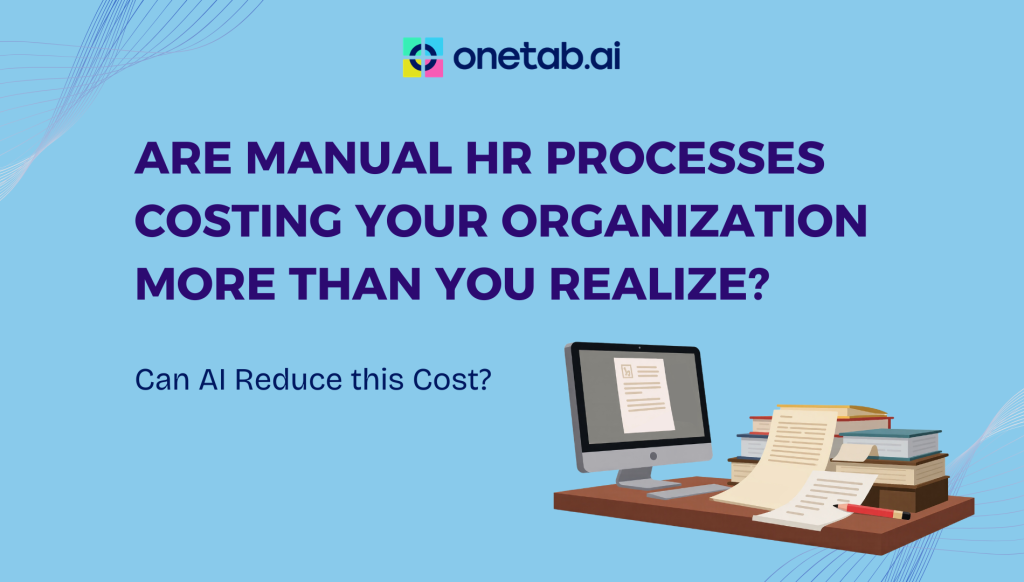
HR teams are the backbone of every organization. Yet in many companies, HR still runs on spreadsheets, emails, disconnected tools, and manual approvals.
On the surface, it may look manageable. Behind the scenes, it’s expensive.
Manual HR operations don’t just consume time, they quietly drain productivity, increase compliance risks, slow hiring, and inflate operational costs.
Let’s break down the real hidden costs and how AI eliminates them.
1. The Cost of Time: Death by Administrative Tasks
Most HR teams spend 60–70% of their time on:
- Resume screening
- Interview scheduling
- Document verification
- Payroll data entry
- Offer letter creation
- Employee queries
- Compliance paperwork
Every repetitive task reduces time available for strategic work like talent planning, engagement, and retention.
Hidden Cost:
- Slower hiring cycles
- Burnout among HR teams
- Reduced focus on employee experience
- Opportunity cost of delayed placements
Multiply that across hundreds of candidates and employees, the impact compounds quickly.
2. The Cost of Delayed Hiring
Manual resume screening and coordination slow down recruitment pipelines.
If it takes:
- 3–5 days to shortlist candidates
- Multiple email threads to schedule interviews
- Manual offer processing
Top candidates drop off.
Hidden Cost:
- Lost talent
- Increased time-to-fill
- Higher cost-per-hire
- Revenue loss (especially for staffing firms)
In competitive markets, speed is revenue.
3. The Cost of Human Error
Manual processes increase risk of:
- Payroll miscalculations
- Incorrect tax deductions
- Missing compliance documents
- Data entry mistakes
- Version control errors in contracts
Hidden Cost:
- Legal penalties
- Rework time
- Employee dissatisfaction
- Damaged employer brand
One payroll mistake can cost more than a year of automation investment.
4. The Cost of System Fragmentation
Many HR teams use separate tools for:
- ATS
- Payroll
- Compliance
- Onboarding
- Employee management
Without integration, HR professionals manually transfer data between systems.
Hidden Cost:
- Duplicate data entry
- Inconsistent records
- Lack of real-time visibility
- Higher IT maintenance overhead
Disconnected systems create invisible friction across the organization.
5. The Cost of Limited Scalability
When HR operations are manual, growth means:
- Hiring more HR staff
- Increasing operational expenses
- Adding more administrative overhead
This creates a linear growth model:
More employees = More HR workload = More cost
That model is unsustainable.
How AI Eliminates These Hidden Costs
Modern AI platforms like Onetab.ai approach HR differently not as a set of tasks, but as an integrated workflow ecosystem.
Here’s how AI transforms HR operations:
1. AI Resume Screening at Scale
- Process 100+ resumes per minute
- Auto-rank candidates
- Extract and validate candidate data
- Reduce screening time by up to 90%
Result: Faster shortlisting, improved quality of hire, lower recruiter fatigue.
2. Autonomous Workflow Automation
AI agents can:
- Schedule interviews automatically
- Generate offer letters
- Trigger onboarding workflows
- Respond to employee queries
- Update HR systems in real time
Result: End-to-end automation without manual follow-ups.
3. Document Intelligence & Compliance Automation
- Auto-verify compliance documents
- Extract payroll data accurately
- Flag missing information
- Maintain audit trails
Result: Reduced legal risk and near-zero manual errors.
4. Unified System Integration
AI can integrate with:
- ATS
- Payroll systems
- CRM
- ERP
Instead of HR teams switching tabs, AI orchestrates workflows across systems.
Result: One intelligent interface. Complete visibility.
5. Non-Linear Scalability
With AI:
- Increased hiring volume doesn’t require proportional HR hiring
- Workflows run autonomously
- Operational costs stabilize even as business grows
This shifts HR from a cost center to a scalable growth engine.
The ROI of AI in HR Operations
Organizations adopting AI-driven HR automation report:
- Up to 90–99% reduction in manual effort
- Faster hiring cycles
- Lower operational costs
- Improved candidate experience
- Better compliance control
- Higher recruiter productivity
Most importantly, HR teams move from administrative execution to strategic leadership.
The companies that eliminate hidden operational costs today will gain a structural advantage tomorrow.
Final Thought
If your HR team is overwhelmed, it’s not a people problem. It’s a process problem.
And processes are exactly what AI is designed to fix.The question isn’t whether AI will transform HR.
It’s whether your organization will lead the change or struggle to keep up.