Kashish Rugwani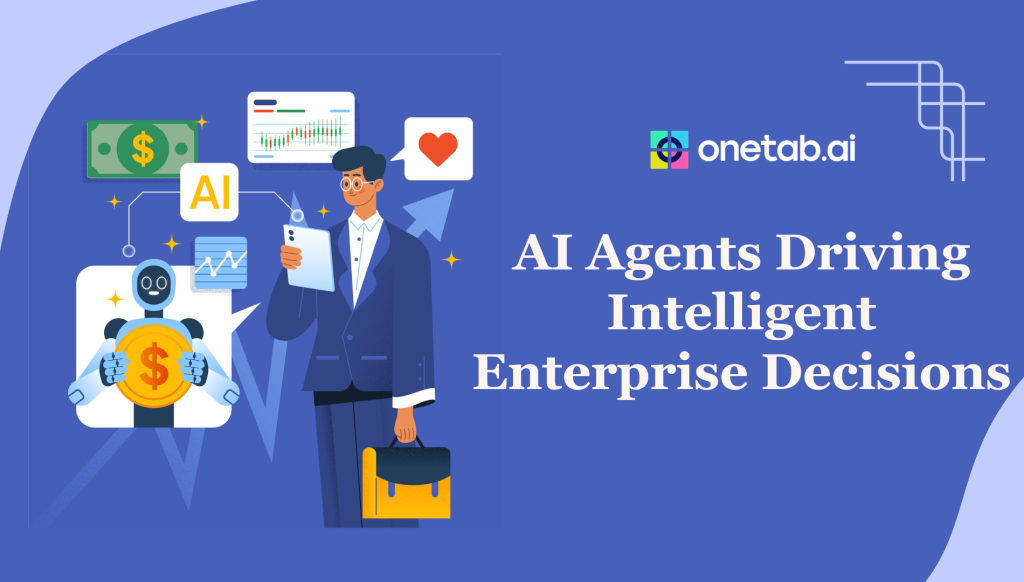
In today’s data-driven economy, enterprises are no longer struggling with a lack of information, they’re overwhelmed by it. The real challenge lies in making accurate, timely, and strategic decisions from massive, complex datasets.
This is where AI agents are transforming the landscape. Unlike traditional automation tools, AI agents don’t just process data, they analyze, learn, and act autonomously. By combining intelligence with execution, they enable enterprises to move from reactive decision-making to proactive and predictive strategies.
What Are AI Agents in Enterprise Context?
AI agents are autonomous systems designed to perform tasks, make decisions, and continuously improve based on data and feedback. They can:
- Analyze structured and unstructured data
- Identify patterns and trends
- Make recommendations or decisions
- Execute workflows without human intervention
In enterprise environments, these agents operate across functions – HR, sales, operations, finance—bringing intelligence directly into business workflows.
The Decision-Making Challenge in Enterprises
Before understanding the impact, it’s important to recognize the common bottlenecks enterprises face:
- Data silos across departments
- Delayed insights due to manual analysis
- Human bias affecting critical decisions
- Inconsistent processes leading to variability
- Lack of real-time intelligence
These challenges result in slower, less accurate decisions impacting growth and competitiveness.
How AI Agents Enhance Decision-Making
1. Real-Time Data Analysis
AI agents process vast amounts of data instantly, enabling real-time insights. Instead of waiting for reports, decision-makers get up-to-date intelligence as events unfold.
Impact: Faster response times and agile decision-making.
2. Predictive Intelligence
AI agents use historical data and machine learning models to forecast outcomes, trends, and risks.
Example: Predicting customer churn, hiring success rates, or sales conversions.
Impact: Shift from reactive to proactive decision-making.
3. Reduction of Human Bias
Human decisions are often influenced by cognitive biases. AI agents rely on data-driven logic, ensuring more objective and consistent outcomes.
Impact: Improved accuracy and fairness in decisions.
4. Automated Decision Execution
AI agents don’t just recommend, they act. From shortlisting candidates to triggering workflows, they execute decisions within predefined rules.
Impact: Reduced dependency on manual intervention and faster implementation.
5. Continuous Learning and Optimization
AI agents improve over time by learning from outcomes and feedback loops. This ensures that decision-making becomes smarter and more refined with usage.
Impact: Long-term efficiency and performance gains.
6. Cross-Functional Intelligence
AI agents integrate with multiple systems (CRM, ATS, ERP), breaking down silos and providing a unified view of data.
Impact: Holistic decision-making across departments.
Use Cases Across Enterprise Functions
Recruitment & HR
- Intelligent resume screening and ranking
- Predictive hiring success analysis
- Automated candidate engagement
Sales & Marketing
- Lead scoring and prioritization
- Customer behavior prediction
- Campaign performance optimization
Operations
- Workflow optimization
- Demand forecasting
- Resource allocation
Finance
- Risk assessment
- Fraud detection
- Financial forecasting
Business Impact of AI-Driven Decision-Making
Enterprises adopting AI agents are seeing measurable outcomes:
- Faster decision cycles
- Improved accuracy and consistency
- Reduced operational costs
- Higher productivity across teams
- Better strategic alignment
In many cases, organizations report up to 50–70% improvement in process efficiency when AI agents are embedded into workflows.
Why Enterprises Are Moving Toward Agentic AI
Traditional automation focuses on predefined rules. AI agents, however, bring autonomy and intelligence together, creating systems that can think, decide, and act independently.
This evolution from automation to autonomy is what defines the next generation of enterprise decision-making.
How Onetab AI Enables Intelligent Decision-Making
At Onetab AI, we empower enterprises with agentic workflow automation that goes beyond basic task execution.
Our platform:
- Uses AI agents to analyze and rank data in real time
- Automates end-to-end workflows across business functions
- Provides actionable insights with minimal manual effort
- Continuously learns and optimizes decision outcomes
Whether it’s hiring the right talent, prioritizing leads, or optimizing operations, Onetab AI helps businesses make smarter, faster, and more reliable decisions.
Conclusion
AI agents are not just tools, they are decision enablers. By combining data intelligence, automation, and continuous learning, they redefine how enterprises operate and compete.
As businesses move toward more autonomous systems, the ability to make intelligent decisions at scale will become a key differentiator.
Organizations that adopt AI agentic workflows today are not just improving efficiency, they are building the foundation for the future of intelligent work.