For the past couple of years, most conversations around AI have been dominated by prompts. Write this. Summarize that. Generate something.
But a quiet shift is happening. We’re moving from AI that responds to AI that acts.
Welcome to the world of agentic AI, where systems don’t just assist with tasks, they take ownership of outcomes.
The big question, though, is:
What can AI agents actually do today (beyond the hype)? Let’s break it down with real, working use cases.
From Tools to Teammates
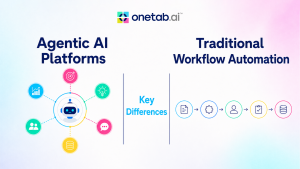
Traditional AI tools wait for instructions. AI agents, on the other hand:
- Understand goals
- Break them into steps
- Use tools and data
- Take action (with or without human input)
- Learn and improve over time
Think less “assistant” and more “junior teammate who never sleeps.”
If you explore platforms like Mie, you’ll notice how the focus is already shifting toward AI that interacts, understands context, and executes tasks, not just responds.
1. End-to-End Workflow Automation
This is where AI agents are already delivering real value. Instead of automating parts of a workflow, agents can manage the entire flow.
Example: Lead Management
- Capture inbound leads
- Enrich data (company, role, intent)
- Score and prioritize
- Trigger personalized outreach
- Schedule meetings
What used to require 3–4 tools and manual coordination can now run as a single, continuous system.
Platforms like Onetab are moving in this direction, helping teams structure and act on data flows, rather than just store or process them.
2. Intelligent Customer Support
Basic chatbots follow scripts.
AI agents:
- Understand context across conversations
- Pull data from multiple systems (CRM, knowledge base, orders)
- Resolve queries end-to-end
- Escalate only when necessary
Real impact:
- Faster resolution times
- Reduced support load
- 24/7 consistent experience
This is where conversational AI platforms (like Mie) start behaving less like bots and more like problem-solvers.
3. Autonomous Research & Insights
AI agents can now handle multi-step research tasks that used to take hours. Example: Market Research Agent
- Define the scope
- Search across sources
- Extract relevant data
- Summarize insights
- Present structured output
Instead of asking multiple prompts, you assign a goal: “Analyze competitors and highlight positioning gaps.” The agent figures out the rest.
4. Content Creation at Scale (With Direction)
We’ve all seen AI generate content. But agents take it further by managing the process.
Example: Content Pipeline Agent
- Identify trending topics
- Generate outlines
- Draft blogs/posts
- Optimize for SEO
- Schedule publishing
The difference? Consistency and continuity, without constant human prompting.
5. Sales Outreach & Follow-Ups
One of the most practical applications today. AI agents can:
- Personalize outreach based on prospect data
- Send sequences across email/LinkedIn
- Track engagement
- Adjust messaging dynamically
- Follow up automatically
This turns sales from a manual grind into a semi-autonomous system.
When paired with structured data systems like Onetab, this becomes even more powerful, because better data = better decisions by agents.
6. Internal Operations & Task Management
Inside organizations, agents are acting as operational copilots. Examples:
- Turning meeting notes into action items
- Assigning tasks and tracking completion
- Sending reminders and updates
- Generating reports automatically
Instead of managing tools, teams focus on decisions.
7. Data Monitoring & Decision Support
AI agents can continuously monitor data and act when needed. Example:
- Track key metrics (sales, churn, performance)
- Detect anomalies
- Alert stakeholders
- Recommend actions
This moves businesses from reactive → proactive.
Where AI Agents Still Struggle
Let’s be real, this isn’t magic. AI agents today still face limitations:
- They need clear goals and boundaries
- Complex decision-making can require human oversight
- Reliability varies depending on setup
- “Fully autonomous” is still rare in high-stakes environments
The best results come from human + agent collaboration, not replacement.
What This Means for Businesses
The biggest shift isn’t just efficiency. It’s how work gets structured.
Instead of: People using tools to complete tasks
We’re moving toward: People managing agents that complete workflows
This changes:
- Hiring needs
- Productivity benchmarks
- How teams operate day-to-day
Final Thought
AI agents aren’t a future concept. They’re already here, quietly running workflows, supporting teams, and handling tasks end-to-end.
Not perfectly. Not independently in all cases. But meaningfully. The companies that win won’t be the ones using AI occasionally.
They’ll be the ones designing systems where AI agents are part of how work gets done.If you’re exploring this shift, it’s worth looking at how platforms like Mie and Onetab AI are evolving, not just as tools, but as foundations for agent-driven workflows.