
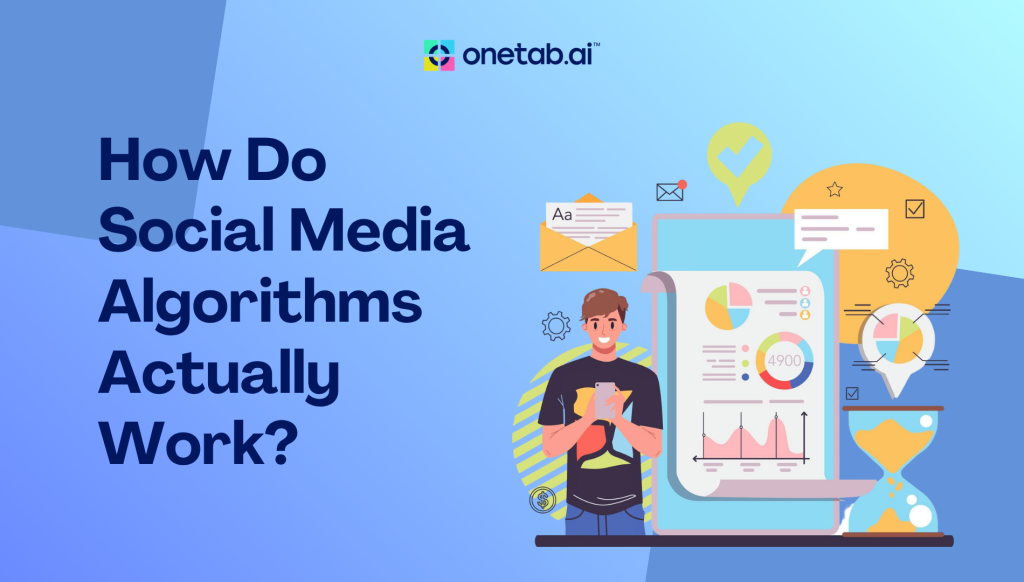
Every time you open Instagram, scroll through TikTok, or watch a video on YouTube, it feels almost… intuitive. The content just fits. Posts you like, videos you finish, topics you care about, they keep showing up.
That’s not luck. That’s the algorithm. But what exactly is happening behind the scenes?
What Is an Algorithm, Really?
At its core, an algorithm is a decision-making system. Its job is simple: Show you the content you’re most likely to engage with.
But to do that, it processes thousands of signals, quietly learning from everything you do.
Step 1: It Watches What You Do (Closely)
Every action you take becomes data:
- What you like
- What you comment on
- What you share
- How long you watch something
- Even what you pause on while scrolling
For example:
- If you watch cooking videos till the end → you’ll see more cooking content
- If you skip dance videos quickly → you’ll see fewer of them
Over time, the algorithm builds a behavior profile of you.
Step 2: It Learns Your Preferences
This is where things get interesting. Algorithms don’t just track what you say you like, they learn what you actually engage with.
You might think you’re interested in productivity content, but if you consistently spend more time watching travel reels… guess what wins?
Your behavior > your intention
That’s how platforms predict what you’ll enjoy next, often before you even realize it yourself.
Step 3: It Ranks Content in Real Time
Every time you open an app, thousands of posts are competing for your attention.
The algorithm ranks them based on questions like:
- “How likely is this user to engage with this?”
- “Will they watch this till the end?”
- “Will they share it or scroll past?”
The highest-scoring content gets pushed to the top of your feed.
Step 4: It Continuously Adapts
Here’s the part most people miss: Your feed is never fixed.
Even a few minutes of different behavior can shift what you see.
- Start engaging with fitness content → your feed changes
- Ignore certain topics → they slowly disappear
- Interact with new creators → your content mix evolves
It’s a constantly updating loop:
You act → Algorithm learns → Feed changes → You react
The Hidden Layer: Similar Users
Algorithms also look beyond you. They analyze people with similar behavior patterns:
- “Users like you also enjoyed this”
- “People who watched this also watched…”
That’s why you sometimes discover content you didn’t even search for, but instantly like.
What’s Good About It:
- Personalized, relevant content
- Easier discovery of things you enjoy
- Less time searching, more time consuming
What’s the Trade-Off:
- You may see less diverse viewpoints
- It can create a “bubble” of similar content
- It encourages longer screen time (by design)
Can You Control Your Feed?
Yes, more than you think. You can “train” your algorithm by:
- Engaging more with content you want to see
- Ignoring or skipping what you don’t
- Using “Not Interested” options
- Following creators intentionally
Think of it like this: Your feed is a reflection of your habits.
Final Thought
Algorithms aren’t inherently good or bad, they’re tools. They’re designed to keep you engaged.
But how they shape your experience depends on how consciously you use them.
So next time you’re scrolling, ask yourself: Am I choosing this content… or is it choosing me?

 Kashish Rugwani
 Onetab
 Alok Patil