Kashish Rugwani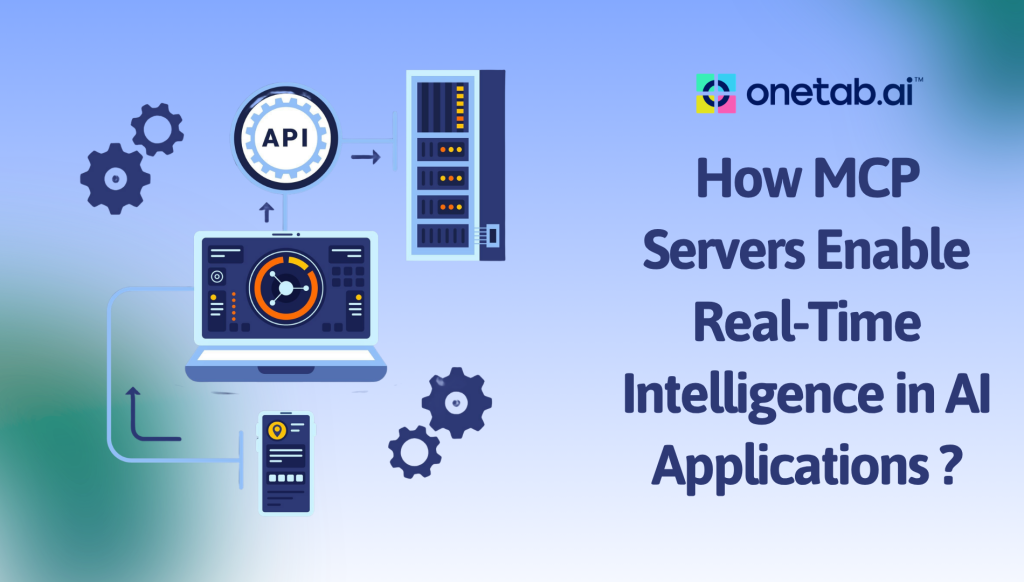
Artificial intelligence has rapidly evolved from static models answering isolated queries to dynamic systems capable of reasoning, decision-making, and automation. However, one fundamental limitation continues to constrain AI systems: lack of real-time, structured context.
This is where MCP (Model Context Protocol) servers are emerging as a critical layer in modern AI infrastructure.
What is MCP?
Model Context Protocol (MCP) is a standardized way to connect AI models (like LLMs) with external data sources, tools, and systems in real time.
An MCP server acts as a context bridge between:
- AI models (LLMs, agents)
- External systems (CRMs, databases, APIs, internal tools)
Instead of relying only on static prompts or pre-trained knowledge, MCP allows AI systems to pull relevant, structured context dynamically at runtime.
What Does an MCP Server Do?
An MCP server performs three core functions:
1. Context Retrieval
It fetches relevant data from connected systems:
- Candidate data from ATS
- Customer data from CRM
- Documents, logs, or internal databases
This ensures the AI is not guessing, it’s working with real data.
2. Context Structuring
Raw data is messy. MCP servers:
- Clean and normalize data
- Convert it into AI-readable formats
- Prioritize relevant signals
This improves accuracy and response quality.
3. Context Injection
The processed data is injected into the AI model’s input before it generates a response.
This enables:
- Personalized outputs
- Context-aware decisions
- Task-specific reasoning
Why MCP Servers Are Becoming Critical
1. AI Without Context Is Limited
Traditional LLMs:
- Don’t know your business data
- Can’t access real-time updates
- Struggle with personalization
MCP solves this by making AI context-aware.
2. Rise of AI Agents
Modern AI systems are shifting toward agents that take actions, not just answer questions.
Agents need:
- Memory
- Real-time data
- System integrations
MCP provides the infrastructure to support all three.
3. Shift from Prompt Engineering → Context Engineering
Earlier, performance depended on:
- Writing better prompts
Now, performance depends on:
- Providing better context
MCP enables systematic context engineering at scale.
4. Enterprise Adoption Requires Integration
Businesses already use multiple tools:
- ATS
- CRM
- HRMS
- Internal dashboards
MCP acts as a unified integration layer, allowing AI to work seamlessly across these systems without rebuilding everything.
5. Improved Accuracy and Reduced Hallucinations
When AI has access to real data:
- Responses are grounded
- Errors are reduced
- Trust increases
This is critical for enterprise use cases like hiring, finance, and operations.
How Users Can Use MCP Servers
1. For Developers
Developers can:
- Build MCP servers to connect APIs, databases, and tools
- Define what context should be fetched and when
- Integrate MCP with AI applications or agents
2. For Product Teams
Product teams can use MCP to:
- Build smarter AI features
- Enable real-time personalization
- Reduce dependency on complex backend logic
3. For Businesses (Non-Technical Users)
Businesses benefit indirectly through applications powered by MCP:
- Recruitment: AI screens resumes using real candidate data
- Sales: AI assistants pull live deal and pipeline insights
- Support: AI responds with customer-specific context
Real-World Use Case: Recruitment
Without MCP:
- AI reads resumes in isolation
- No access to job requirements or company data
With MCP:
- AI pulls:
- Job descriptions
- Candidate history
- Hiring criteria
Result:
- Better candidate matching
- Faster screening
- More accurate rankings
How Onetab AI Uses MCP
Onetab AI leverages MCP servers to connect real-time hiring data with AI workflows, enabling smarter resume screening, candidate evaluation, and decision-making.
By integrating MCP, Onetab AI transforms recruitment into a context-aware, automated system that improves accuracy, speed, and hiring outcomes.
The Future: MCP as Core AI Infrastructure
As AI systems become more:
- Autonomous
- Context-aware
- Action-driven
MCP servers will evolve into a default architectural layer, similar to how APIs became essential for web applications.
We are moving toward a world where:
AI doesn’t just respond, it understands, decides, and acts based on real-time context.
Final Thoughts
MCP servers are not just another tool, they represent a fundamental shift in how AI systems are built and deployed.
By enabling real-time context, seamless integrations, and intelligent decision-making, MCP is transforming AI from a static assistant into a dynamic, context-aware system.
For any organization building or adopting AI, the question is no longer:
“Should we use MCP?”
But rather:
“How soon can we integrate it into our stack?”