Kashish Rugwani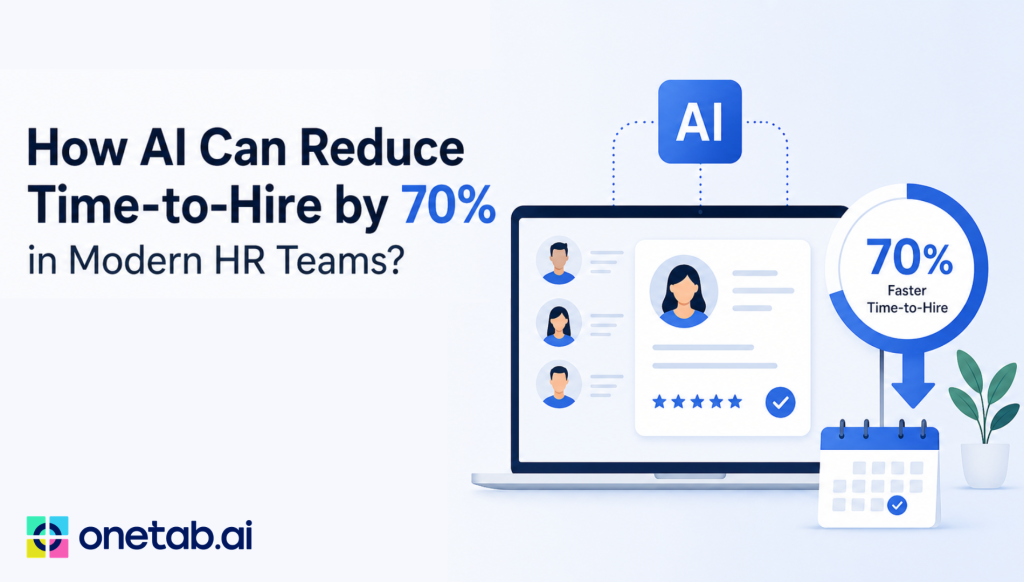
The professional and talent market at present is quite competitive, where speed and time are everything. Companies that end up identifying, evaluating and hiring the best candidates faster as compared to the competitors eventually win the talent war. Still, the usual time to hire manually across most of the industries revolves around 30–45 days, which is around 6 weeks of increased cost, lost productivity, and the risk of losing the right candidates towards faster functioning competitors.
AI in recruitment platforms are now transforming this equation, mainly with leading companies, reporting major reductions in the time needed to hire.
Table of contents:
- Introduction
- Time to hire problems in manual methods
- How AI Can Reduce Time-to-Hire by 70% in Modern HR Teams
- Reduce Time-to-Hire in Modern HR Teams With Onetab.AI
- Conclusion
- FAQs
Time-To-Hire Problems In Manual Methods
Before we look for the solutions, it is essential to clearly acknowledge where and how most of the time is consumed in the traditional hiring process. There are multiple essential steps in recruitment process, with each having its own drawbacks:
- Job posting and sourcing:
Writing and creating well-formatted job descriptions, posting them on different boards and then waiting to receive applications consumes around 5–10 days.
- Resume screening:
Reviewing hundreds or thousands of resumes manually to identify and shortlist the right candidates is one of the most hectic tasks in the entire traditional hiring process. Each organisation requires at least 1–2 weeks to finally shortlist the best candidates from hundreds of resumes.
- First outreach:
The initial outreach process includes connecting with the candidates to schedule interviews. As there are multiple candidates to connect with separately, it takes around 4 to 7 days to do the same.
- Interviews:
There are multiple interview rounds scheduled by different companies. Each interview stage takes place with different managers or stakeholders. Performing rounds for each and every candidate consumes around 20 to 21 days at least.
- Onboarding:
Once the candidates are chosen, post interview rounds, companies need to perform background checks, go for negotiations and other paperwork, including taking around a week to finally onboard the chosen candidates.
How AI Can Reduce Time-to-Hire by 70% in Modern HR Teams
By integrating AI recruiting platforms, organisations can reduce time to hire in the following ways:
- AI resume screening:
Juggling through stacks of resumes is among the most time-consuming tasks in the hiring process. However, with AI in recruitment process, companies can boost time-to-hire efficiency in the following ways:
- Efficiency and speed
AI recruitment systems can scan hundreds of resumes in just a few minutes. On the other hand, manual shortlisting of resumes consumes multiple days or even weeks for a single hire.
- Skill and keyword matching
Advanced AI recruiting tools monitor specific experiences and keywords aligning with the job descriptions, as it helps companies manage hiring challenges efficiently.
- Candidate matching and sourcing
Getting your hands on the perfect candidates for any position may be time-intensive and challenging. AI for HR minimises time to hire, along with improving candidate sourcing and matching in the following way:
- Automated searches
AI-integrated tools scan huge databases and job portals to graph candidates whose experiences and skills align with job descriptions.
- Better fit analysis
AI algorithms utilise data analysis to find and match applicants with job roles. They are highly suited for.
- Streamline the interview process
Interview coordination stands as a logistical challenge, especially when an organisation deals with multiple interviewers and candidates. AI in recruitment process helps streamline the entire process with automation through :
- Automated scheduling
AI in recruitment systems coordinate between interviewers and candidates to arrange timeslots, reducing the downtime consumed on unclear communications.
- 24/7 functionality
Interview scheduling AI-powered tools work 24/7, helping companies enhance time to hire, in addition to the regular office working hours.
- Lesser human error
Interview scheduling automation reduces the risk of missing important details or double booking interviews.
- Improved candidate assessments
Evaluating experience, skills, and other factors of candidates for a particular role is important, but it is a lengthy process if done manually. AI-driven assessments can enhance the overall experience of the candidates through :
- Automated skill assessment
AI-powered simulations and tests help in measuring the competencies and skills of candidates without manual oversight.
- Customized evaluations
HR management systems can integrate AI recruiting tools to personalise assessments according to a specific job requirement, providing more relevant and accurate results.
- Real-time analysis
AI in recruitment process provides results of assessments quickly, along with insight into the performance of a candidate, helping hiring managers make better decisions.
- Background checks and verification
Before hiring a candidate, it is vital to perform a background check. Through AI-powered tools, companies can streamline the process by:
- Background check automation
AI recruiting tools can verify the educational backgrounds, certifications, and employment history of a candidate quickly.
- Constant monitoring
Certain AI-powered tools provide real-time monitoring of the newly hired employees to maintain compliance.
- Faster turnaround
AI for HR solutions cross-track multiple databases instantly, speeding up background checks by almost 70%.
Reduce Time-to-Hire in Modern HR Teams With Onetab.AI
With Onetab.AI, experience everything automated from recruiting to employee engagement. No lengthy hiring procedures; with our AI-powered recruitment solutions, parse hundreds of resumes in seconds, shortlist candidates, use semantic AI, automate interviews, schedule across calendars, validate onboarding documents on the go and whatnot!
Our one conversational AI agent connects with the HR management systems you use and automates tasks in just a few seconds.
Conclusion
Integration of AI in recruitment has transformed the process by minimising time to hire at almost every stage, from resume screening to performing background checks. This end-to-end revolution demonstrates the way AI reduces time to hire.
By enhancing communication, automating repetitive recruitment-related tasks and using predictive analytics for informed, better decision-making, AI lets hiring managers, HR professionals and recruitment agencies focus on other human-driven strategy activities.
Solutions such as Onetab.AI offer all these capabilities altogether in a single platform, letting organisations build stronger pipelines, hire faster, and scale recruitment effortlessly without compromising on quality.
FAQs
Q1. Can AI enhance candidate matching?
Yes, AI-powered hiring solutions enhance candidate matching by acknowledging job requirements, along with candidate experiences, profiles, and skills. Moreover, advanced algorithms shortlist the perfect fit candidates for certain roles, offering precision in the candidate selection process along with reducing mismatches.
Q2. How can recruitment automation manage candidate assessments?
AI-powered recruitment platforms perform candidate assessments by utilising tools such as personality quizzes, skill tests, and simulated job scenarios. Such tools monitor candidates in detail and offer insights into their abilities, ensuring a transparent and fair selection process.
Q3. How does Onetab.AI simplify payroll management?
This platform offers payroll intelligence and reconciliation. Cross-reference payroll functions against leave records, timesheets, and benefits deductions. It can also flag discrepancies, if any, before the payroll closes and can also generate automated variance reports.
Q4. In what ways does AI support remote hiring?
AI recruitment platforms simplify the remote hiring processes by enabling online assessments, virtual interviews and document sharing. It offers seamless communication between recruiters and candidates, irrespective of geographic location, making it an ideal recruitment solution for remote-first companies.