Resume parsing and screening are the backbone of today’s talent acquisition solutions. When organisations and businesses perform mass hiring, expand through geographies and seek candidates with specialised skills, early stage screening itself determines if the hiring systems fasten up or collapse due to volume. At present, a majority of organisations have started switching to AI powered recruiting for their hiring procedures.
For years, resuming screening was a mandatory administrative task. Recruiters reviewed resumes manually to filter applications. However, the approach no longer fits. The volume of applications has risen, position requirements are more nuanced, and hiring results are now measured by quality, speed, and experience of activity. Hence, hiring consultancies now prefer AI-powered HR management software for overall efficiency in the recruitment process.
The modern talent acquisition solutions demand smarter and faster AI resume screening. They need intelligence in this process. This blog helps you explore what AI resume parsing is, what makes it the future of smarter, faster candidate screening and the benefits of AI for HR.
Table of contents:
- Introduction
- Limitations of manual resume parsing
- AI resume parsing: Meaning
- AI resume parser: working
- AI resume parsing: the future of smart screening
- Why switch to AI resume parsing?
- AI resume parsing with Onetab.AI
- Conclusion
- FAQs
Limitations Of Manual Resume Parsing
Even when an organisation has experienced recruiters and well-structured workflows, manual screening of resumes eventually slows down the entire hiring process. Some of the limitations of manual screening include the following:
- Major time investment
Hiring teams end up spending hours sifting through stacks of resumes. The process eventually becomes time-consuming as each resume is individually reviewed, which delays shortlisting. Moreover, hiring for different roles altogether becomes a burden, and follow-ups stretch the timelines ahead.
- Risk of subjectivity and bias
Unconscious bias stands as a barrier in manual screening, as even professional recruiters are not immune. At times, the names, education history, or address may trigger unplanned assumptions. The gut feeling decision made by a recruiter replaces a criteria-based resume evaluation. Moreover, strong and worthy candidates might be overlooked because of formatting or other factors.
- Challenging with huge application volumes
Whenever a job post ends up attracting hundreds or thousands of job applicants, traditional methods fail to do the job justice. With no AI integrated HR management software, screening capacity breakdowns, and some of the worthy candidates might have to wait a bit longer and go for other job offers. It also becomes challenging to maintain consistency in final decisions.
AI Resume Parsing: Meaning
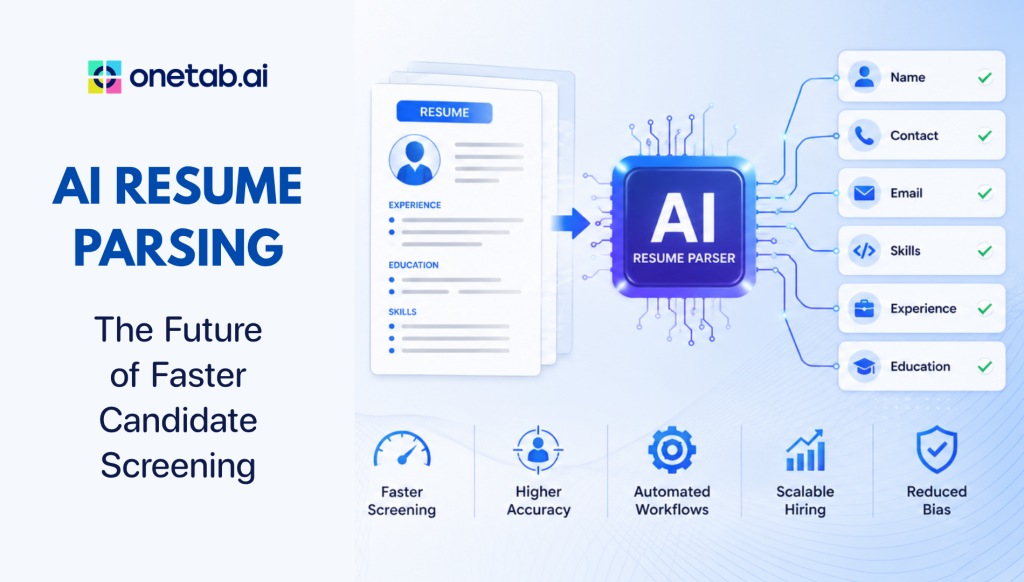
AI resume parsing is an automated procedure of monitoring, analysing and extracting information from several resumes at the same time. Backed by machine learning and natural language processing, an AI recruitment software, such as Onetab.AI, integrated with a resume parser quickly interprets the data from resumes, such as skills, work experience, contact details and education, irrespective of the formatting of the CV.
This AI resume screening process helps recruiters manage huge sets of applications with consistency, accuracy, and speed, eventually reducing dependency on manual and subjective screening. Moreover, agency recruiters integrate AI powered recruiting solutions in their hiring process to not only streamline candidate shortlisting but also support better decision-making from the data.
Some of the key highlights of AI-powered resume parsing are:
- Better data accuracy
- Faster screening of candidates
- Consistent formatting of information
- Reduced manual interference
- Enhanced matching and searching
- A better candidate experience
AI Resume Parser: Working
An AI resume parsing platform utilises trained algorithms to monitor specific patterns and extract the needed information from resumes. This HR automation process starts when a candidate’s resume is uploaded. The AI then scans the entire document and recognises crucial data points, such as skills, job titles, employment history, and education. Later, this information is structured into a format, promoting easy comparison across campaigns and candidates via AI resume screening.
AI Resume Parsing: The Future Of Smart Screening
Resume parsing alone cannot improve the hiring process. Parsing forms structure, however, we get results when the structured data is utilised for better decision-making and screening. With the absence of intelligent screening, even this data remains meaningless and not actionable.
AI resume screening uses the structured data from resumes to monitor candidates across role-relevant factors. Instead of depending on the binary filters or keyword presence, it monitors how well a candidate aligns with the demand and requirements of the role.
The skills-to-job matching examines the depth, relevance, and application of skills in regard to the expectations of the role.
The experience-to-role factor monitors the way a candidate’s industry exposure, roles and tenure fit the contextual and functional demands of the available position. AI for recruiters gives a transparent signal of readiness, along with minimising ambiguity in early evaluation.
By monitoring the candidates across such dimensions, AI resume screening enhances the quality of CV shortlisting and boosts the chances of the interviews, resulting in informed and better decisions. Hence, the interview time is eventually spent on candidates with a better overall fit, preventing waste of time on repeated interview cycles and enhancing both hiring and outcome quality.
Why Switch To AI Resume Parsing?
AI-powered resume parsing and screening come with some great advantages for the hiring teams. They are:
- Enhanced processing speed
AI resume screening can process around 1000+ resumes in just a few minutes, as compared to a manual one, covering the applicant review process up to 80% faster.
- Reduced hiring time
AI for recruiters minimises hiring time by around 50–70% via automated candidate qualification and ranking, with positions remaining vacant for shorter durations.
- Better consistency
AI in recruitment eliminates the chances of errors that occur in human screening with consistent evaluation across all the available applications, without oversight or fatigue.
- Improved candidate identification
AI for HR is capable of identifying passive candidates just by scanning for certain industry experience and transferable skills, which may be missed through manual reviews.
AI Resume Parsing With Onetab.AI
Resume parsing and screening are no longer manual employee functions. With the integration of AI in recruitment, the entire HR automation process becomes trustworthy, speedy and of high-quality work.
Onetab.AI enables AI-powered resume parsing and screening. With this platform, you can automate recruiting, compliance, onboarding, payroll and even employee engagement. This one agent is capable of handling your complete HR life cycle, starting from the first job post to retirement, with AI built in each step. Onetab.AI brings to you a completely new and smart way of managing recruitment-related tasks, including:
- AI-powered talent acquisition
- Intelligent onboarding automation
- Real-time workforce analytics
- Compliance and policy automation
- Employees self-service chatbot
- Performance and review automation
- Payroll intelligence and reconciliation
- Multisystem orchestration through MCP
- Learning and development tracking
Switch to Onetab.AI today and transform the recruitment process with AI.
Conclusion
Resume parsing is the first process determining which candidates enter the hiring process. By integrating AI in recruitment platforms, built with end-to-end orchestration, experience everything from screening to functioning as a connected hiring system rather than individual steps. AI resume screening brings role clarity, interviews, assessments, and outcomes and helps organisations switch to high-quality recruitment decisions. For a completely revolutionised, smarter and faster hiring process, switch to Onetab.AI today!
FAQs
Q1. How can you differentiate between resume screening and resume parsing?
Resume parsing is the process of extracting data from the uploaded resume, while resume screening monitors that data in order to acknowledge candidate relevance. Screening implements criteria, such as experience, skills, and role fit, to choose what candidates will move ahead in the hiring process. Hence, parsing results into screening, but screening is the ultimate process for hiring decisions.
Q2. How does AI enhance accuracy in resume screening?
Yeah, enhances, resuming screening by monitoring candidates in addition to keyword matching. AI screening analyses the skills of the candidates, identifies transferable capabilities, and interprets experience patterns. This eventually improves shortlist quality, reduces noise and enhances the interview-to-hire ratios.
Q3. How does Onetab.AI help with talent acquisition?
With HR automation via this platform, you can parse around 1000 resumes in just a few seconds. In addition, this platform ranks candidates according to job fit scores through semantic AI, automatically generates personalised outreach and also schedules interviews on the calendar without any manual clicks.