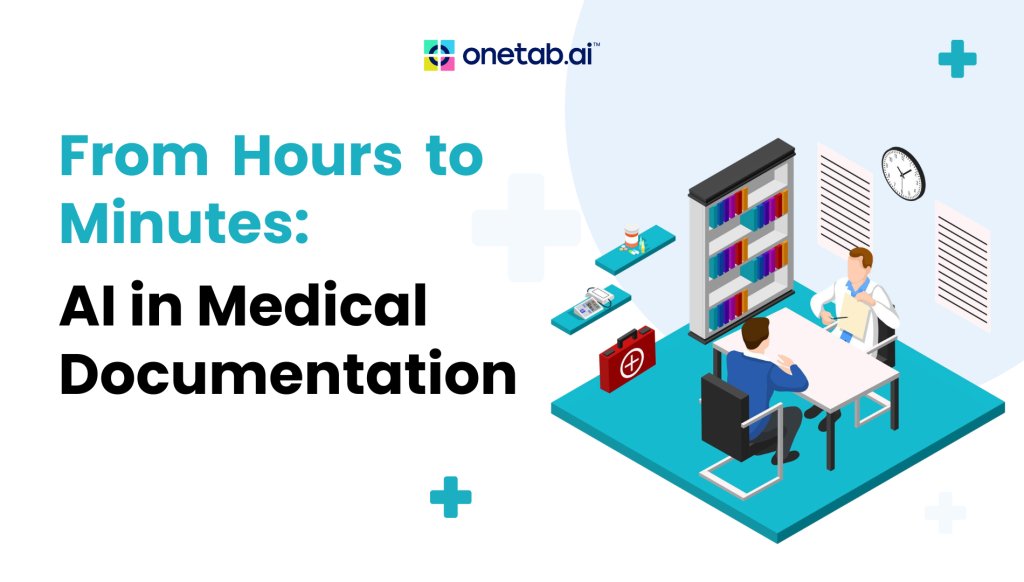
In today’s healthcare environment, time is one of the most valuable and limited resources. Between patient care, administrative duties, and compliance requirements, clinicians often find themselves spending more time documenting than actually treating patients.
Medical documentation, while essential, has become a major bottleneck. But with the rise of AI, that’s rapidly changing.
The Documentation Burden in Healthcare
Doctors, nurses, and administrative staff spend hours every day on tasks like:
- Writing patient notes
- Updating electronic health records (EHRs)
- Managing discharge summaries
- Documenting consultations and follow-ups
Studies consistently show that clinicians can spend up to 40–50% of their time on documentation. This not only reduces efficiency but also contributes to burnout and decreased patient satisfaction.
Enter AI: A Smarter Way to Document
AI-powered tools are transforming how medical documentation is handled by automating repetitive, time-consuming tasks. Instead of manually typing or dictating notes, healthcare professionals can rely on AI to:
- Convert conversations into structured clinical notes
- Auto-fill patient records from multiple systems
- Generate summaries of visits, lab results, and diagnoses
- Standardize documentation for compliance and accuracy
The result? Faster, more consistent, and significantly less effort.
How AI Saves Hours Every Day
1. Real-Time Transcription and Note Generation
AI can listen to doctor-patient interactions and instantly convert them into structured notes. This eliminates the need for post-consultation documentation.
2. Intelligent Data Extraction
Instead of switching between systems, AI can pull relevant data lab results, prescriptions, history and compile it into a single, coherent record.
3. Automated Summaries
From discharge summaries to follow-up instructions, AI can generate clear, concise documents in seconds.
4. Error Reduction and Standardization
AI ensures consistency in terminology and formatting, reducing errors and improving compliance with medical standards.
Impact on Healthcare Professionals
The benefits go beyond just saving time:
- Reduced burnout: Less administrative burden means more focus on patient care
- Improved efficiency: Faster workflows and quicker turnaround times
- Better patient interaction: Doctors can engage more meaningfully without being glued to screens
- Higher accuracy: Structured, AI-generated documentation minimizes human error
What This Means for Healthcare Organizations
For hospitals and clinics, automating documentation leads to:
- Increased operational efficiency
- Lower administrative costs
- Faster billing and claims processing
- Improved data accessibility across departments
When documentation becomes seamless, the entire system runs smoother.
The Future: Fully Integrated AI Workflows
The real power of AI comes when documentation isn’t a standalone tool but part of a centralized system.
Imagine a single AI agent that:
- Listens to conversations
- Updates records in real time
- Answers staff queries instantly
- Connects across EHRs, labs, and billing systems
That’s where healthcare is heading toward fully integrated, AI-driven operations where documentation happens automatically in the background.
Final Thoughts
Medical documentation will always be a critical part of healthcare but it doesn’t have to be a burden.
By leveraging AI, healthcare providers can reclaim hours every day, reduce stress, and refocus on what truly matters: delivering better patient care.
The question is no longer if AI will transform medical documentation it’s how fast organizations are ready to adopt it.

 Yashita Maltare
 Judah Guber