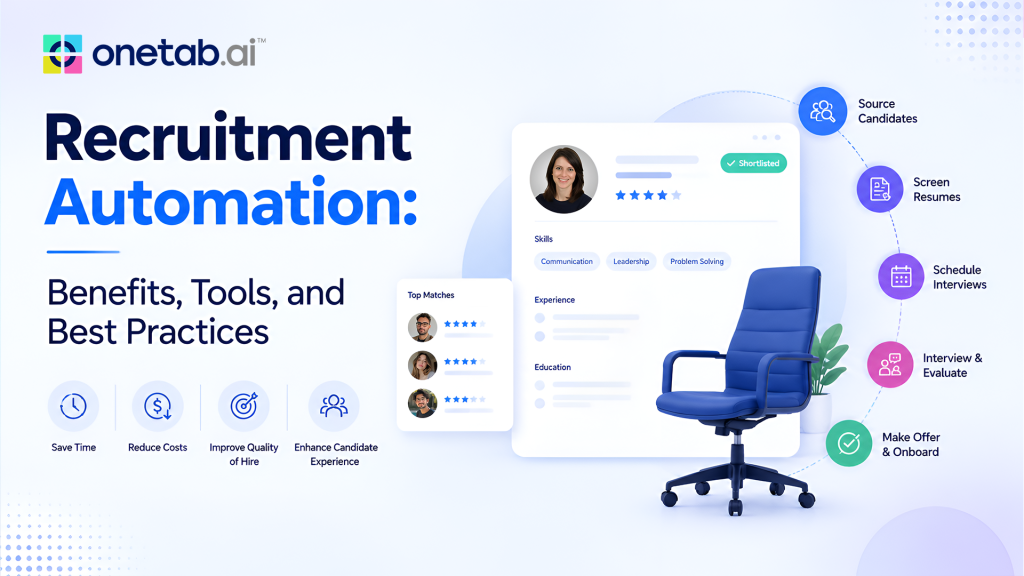
Most recruiters don’t quit because hiring is hard. They quit because it’s tedious. Screening 800 applications for a single role, chasing calendar confirmations, manually parsing resumes that look nothing alike, that’s where the hours go, and it doesn’t require a human to do it. AI recruitment technologies handle that part now, and the HR teams adopting them aren’t just saving time. They’re making better decisions with what’s left.
Table of Contents:
- What Is Recruitment Automation?
- How AI Recruitment Technologies Are Changing Hiring?
- Key Features Of An AI Recruitment Platform
- AI For Employee Onboarding
- Best Practices For Implementing HR Automation
- Benefits Of Automation For HR Teams
- Conclusion
- Faqs
What Is Recruitment Automation?
Recruitment automation uses machine learning, natural language processing, and workflow tools to handle the repeatable parts of talent acquisition. Artificial intelligence in recruitment and selection automates screening, scheduling, candidate communication, and document collection. The point isn’t to remove HR professionals from the process. It’s to stop them from spending 60% of their weekly hours on tasks that a system can do in seconds.
How AI Recruitment Technologies Are Changing Hiring?
Modern AI recruitment tools don’t just sort resumes. They understand context. A system using semantic matching can identify that a candidate with “revenue operations” experience is worth considering for a sales ops role, even if the keyword overlap is low. That kind of reasoning wasn’t possible with keyword-based filtering systems from five years ago.
Here’s what current AI recruitment technologies actually do:
- Parse and rank thousands of resumes against job descriptions using semantic AI, not just keyword matching
- Run structured AI phone screenings simultaneously across dozens of candidates
- Schedule interviews by checking availability across connected calendars without manual coordination
- Monitor compliance requirements across jurisdictions and flag violations automatically
- Generate real-time workforce analytics from plain-language queries, no SQL needed
Key Features Of An AI Recruitment Platform
Not every tool marketed as an AI recruitment platform actually earns the label. Here’s what a genuine, full-lifecycle platform does:
- Resume screening and candidate ranking
Semantic parsing finds qualified candidates faster, without penalising unconventional resumes. A candidate who formatted their career history starting with skills first shouldn’t get buried because the parser expected a chronological layout.
- Automated interview scheduling
After shortlisting, the system books interviews directly into connected calendars, sends confirmations, and follows up with reminders. No back-and-forth happens over emails.
- Multi-system integration
An AI recruitment platform that doesn’t connect to your existing stack isn’t worth using. Platforms like Onetab.AI are designed to integrate with existing HR systems instead of replacing them. Integration with applicant tracking systems, HRIS tools, payroll software, and communication platforms (Slack, Teams) through protocols like Model Context Protocol (MCP) is what turns a tool into an actual workflow.
- Compliance and policy automation
GDPR, SOC 2, labour law updates by jurisdiction, and contract expiry tracking are tedious work that intelligent AI agents for HR handle better than spreadsheets do. Audit-ready reports, automatic stakeholder notifications and violation flags, these are essentials in regulated industries.
- Employee self-service
A 24/7 chatbot that answers PTO queries, payslip requests, and benefits questions cuts HR ticket volume by around 70%, based on platform data. This is a huge operational gain.
AI For Employee Onboarding
Onboarding is where most automation investments stop, which is a mistake. AI for employee onboarding addresses everything, such as document verification, account provisioning, training assignments, and personalised 30-60-90 day plans that run automatically from day one. New hires don’t need to wait three days for IT to provide their access. The system does it when the contract is signed. AI-HR platforms like Onetab.AI help automate these onboarding workflows without adding manual coordination between teams.
Platforms using intelligent AI for employee onboarding report up to 6x faster onboarding completion rates compared to manual processes. AI agents can recommend training paths based on role gaps and career goals, track completion across LMS platforms, and flag when key certifications are about to expire.
Best Practices For Implementing HR Automation
When businesses search for ‘intelligent agents AI for HR’, they’re usually looking to automate high-volume workflows without disrupting existing systems.
- Start with your highest-volume, lowest-complexity tasks: Resume screening, document collection, and interview scheduling are the right entry points. They consume the most recruiter hours and carry the least risk if the AI makes an imperfect call.
- Integrate before you optimise: Connect the platform to existing tools first. Automation for HR that runs in a separate environment, disconnected from your HRIS and calendar, creates data duplication and more manual work, not less.
- Keep humans at the final stage: AI screens, ranks, and schedules. Humans make final calls. That division of labour is the right combination, and it’s also the legally defensible one in most jurisdictions.
- Track the right metrics from the start: Time-to-hire, candidate drop-off rates, onboarding completion times, HR ticket volume. These tell you whether AI recruitment is actually working. Set baselines before deployment so you have something real to compare in six months.
- Confirm compliance requirements upfront: GDPR compliance, data residency rules, and local labour regulations vary significantly by region. Don’t assume the platform covers your jurisdictions. Ask specifically, before you sign anything.
Benefits Of Automation For HR Teams
- Higher recruiter productivity: Less time on administrative tasks means more time on sourcing strategy, candidate relationships, and hiring manager alignment.
- Better candidate experience: Candidate drop-off during long hiring cycles is a direct function of poor communication and slow scheduling. Automation for HR fixes both. Instant confirmations, automated status updates, and self-service scheduling reduce the friction that causes qualified candidates to accept competing offers while still waiting to hear back.
- Consistent, auditable decisions: Automated screening applies the same criteria to every application, which reduces the variability that manual review introduces. It doesn’t eliminate bias entirely, but it removes a significant source of it. Every decision also leaves a record, which matters when hiring practices are audited.
- Scale without proportional headcount growth: A recruiting team of eight can process the application volume that previously required fifteen people. It’s the operational reality for staffing agencies running AI recruitment at scale.
Conclusion
AI recruitment is a must-have for competitive HR teams. The tools exist, the integrations are mature enough, and the outcomes are measurable. Screening, scheduling, onboarding, compliance, payroll reconciliation, employee self-service, and automation for HR covers the full lifecycle now, not just the top-of-funnel. Teams that adopt it aren’t replacing recruiters; they’re removing the work that was preventing recruiters from doing their actual job. If your organisation is ready to move, Onetab.AI’s HR agent handles the complete hiring lifecycle through a single conversational AI, connected to every tool in your existing stack.
FAQs
Q1. What recruitment tasks are best suited for AI automation?
Tasks that are high volume and rule-based, like parsing resumes, ranking candidates, scheduling interviews, document collection, compliance checks, etc are very labour-intensive, repetitive, and require no human judgment to do.
Q2. Can AI agents for HR connect to tools we already use?
Yes, and that’s the first thing to verify before choosing a platform. Modern AI recruitment systems can be connected with the applicant tracking systems, HRIS platforms, payroll software, calendar tools, and communication applications via open protocols, such as MCP.
Q3. How does AI help in employee onboarding?
It removes the delays. The document verification, account provisioning and training assignments happen automatically. This means that new hires don’t have to wait a week for access to the accounts and training to be completed by IT or HR.
 Pratish Gopinath
 Saket Dandotia