Most of the businesses cannot operate in a stable environment anymore. Customer priorities fluctuate mid-cycle, pipelines shift weekly, purchasing committees expand, and forecasting assumptions transform faster than traditional workflows can quickly adapt. Several automation systems were created for predictable actions. These systems performed well when each process implemented a fixed path. However, business operations hardly work the same way now.
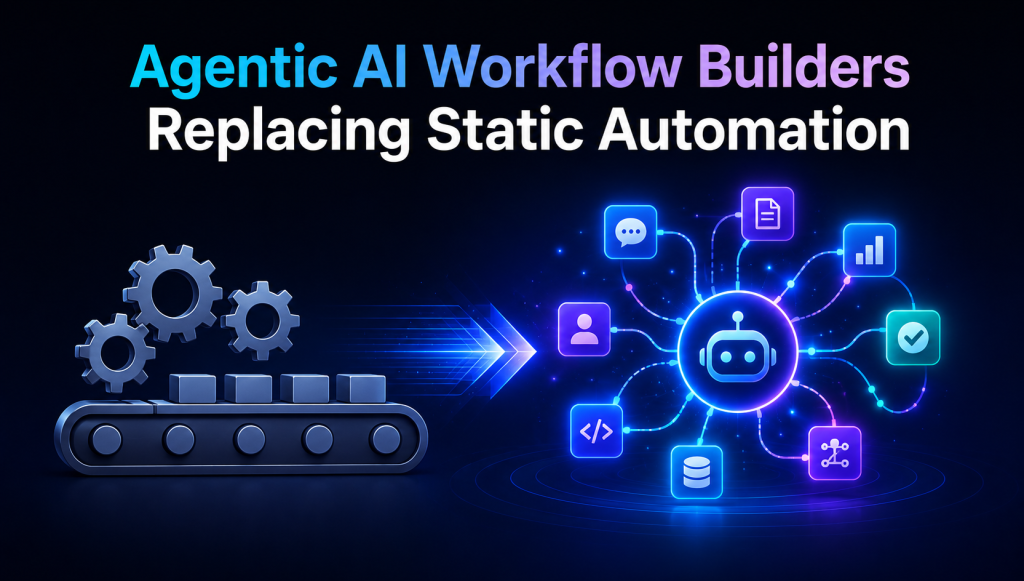
This is where Agentic AI stands vital. Rather than executing static workflows, agentic AI artificial intelligence agency evaluates context, observes fluctuating conditions, and edits actions in real time. Onetab’s agentic AI was designed specifically for this type of dynamic execution. It is highly suitable for organisations that demand an automated workflow capable of adapting, planning and recovering rather than simply following specific instructions.
In this blog, you will explore what AI agents are, the drawbacks of rule-based workflows, why AI agentic is replacing static automation rules and the key benefits of AI agents.
Table of contents:
- Introduction
- Exploring AI agents
- Understanding the Agentic AI workflow builder
- Limitations of Static automation rules
- How agent AI workflow builders are replacing static automation rules
- Key benefits of AI agent workflow builders
- Conclusion
- FAQs
Exploring AI Agents
As businesses step towards greater automation, agent AI stands as a powerful alternative to traditional static automation rules. Unlike predefined, strict logic that means constant, scripting and maintenance, agent AI operates dynamically, understanding context, learning from data and providing results and decisions in real-time. These agents execute advanced workflows, such as predicting incident categorisation, conversational resolution of issues through virtual agents, auto-assigning tasks on the basis of behaviours, and not only rules and proactive anomaly detection.
AI agents are intelligent programs that perceive the given environment, take actions and make decisions to achieve the desired results. Compared to traditional AI-powered tools or scripts, AI agentic utilises natural language, machine learning, and understanding historical data to provide results. Through intelligent behaviours, these agents minimise administrative overhead, provide automation, personalised user experience and increased flexibility.
Understanding the Agentic AI Workflow Builder
Agent AI workflow builders implement a semi-autonomous process, utilising contextual, memory, reasoning, and conditional decision-making to provide results. The workflow describes the way an identical system functions: what it does when and how. This tool of AI for enterprise differentiates from traditional automation scripts that simply follow fixed rules and perform certain tasks without carrying out multi-step procedures.
Agent AI workflow builders are no doubt the best AI tools for business. They are capable of making decisions, planning execution, retaining memory from different operations and integrating other apps or multi-agent collaboration. This agent AI breaks down complicated instructions, offering constant improvement and personalised results. Unlike static models from an artificial intelligence agency, agentic AI workflow builders convert data into knowledge and later translate the same knowledge into action without any human intervention or oversight.
Limitations of Static Automation Rules
Some of the reasons why static automation rules no longer rule the automation workflow systems are as follows:
- Static and strict
Static automation AI-powered tools mostly follow the logic of ‘if-this-then-that’ commands. For any modifications needed towards workflows, manual intervention becomes necessary for system updates. Moreover, the system lacks contextual awareness in order to manage non-standardised workflows. For instance, if a particular incident doesn’t align with the defined conditions, it may be left unassigned or misrouted.
- Lack of improvements and learning
A rule-based automation AI for enterprise doesn’t learn from outcomes, nor does it improve on the basis of previous results. Moreover, these systems do not adapt to fluctuating trends in service, patterns or data.
- Challenging to maintain at scale
With more rules being added, the traditional AI-powered tools’ automation workflow becomes more challenging and complex to manage. Moreover, changing conditions and rules can quickly become old or outdated.
- Dependency on the developer or admin
For rule-based automation, extensive technical resources are needed to test, build, and deploy. This further maximises dependency on developers or system administrators.
How Agent AI Workflow Builders Are Replacing Static Automation Rules?
The following features of agent AI workflow builders highlight what makes it among the best AI tools for business over static automation rules:
- Context-aware decisions
Agent AI workflow builders consider the entire context, such as user history, type, ticket, urgency, and device information. They function beyond static rules and understand the relation between variables.
- Data-driven
Workflow builders of agent AI grasp patterns from historical data and adapt behaviour with time, and not on the basis of predefined logic, such as rule-based systems.
- Constant improvements and learning
Agent AI workflow automation builders also learn from every single interaction. Over time, these agents enhance decision-making and accuracy by reducing the need for manual intervention or updates.
- Interactive and conversational
Integrated with virtual agents, agent AI engages with users through natural language. These agents acknowledge requests and offer real-time guidance or solutions aligning with the user demands and not simply rule-based.
Key Benefits Of AI Agent Workflow Builders
Agent AI workflow builders help organisations achieve a top level of scalability and efficiency, which was once aspirational. By implementing the best AI tools for business, such as agentic AI, businesses can handle complex tasks and workflows autonomously, and respond instantly to changing needs and conditions while giving employees ample time to concentrate on other high-value innovations.
- Stepping beyond efficiency
Traditional rule-based automation can accelerate work, but agentic AI transforms how the work is done. It steps beyond simple task execution to autonomous operations. A significant benefit of agent AI is the flexible management of challenging workflows.
- Resolution and response time
By automating assignment, triage and resolution, agentic AI minimises wait time for the end users. It is also capable of handling repetitive tasks on the spot without any delays.
- Consistency and accuracy
AI agentic workflow automation builders eliminate manual interventions or dependencies, improving the overall logical accuracy and completeness. Moreover, these automation solutions share uniform management of similar situations across multiple teams.
- Lesser operational cost
AI agentic workflow automation builders eliminate manual repetitive tasks via intelligent automation. With fewer escalations and reduced demands for human support, it eventually reduces labour costs.
AI agentic workflow automation builders offer much more than just automating workflows. They unlock faster, smarter, and more adaptive ways of fulfilling tasks. These agents help businesses improve service quality and reduce costs by combining automation and intelligence with personalised workflow builders.
Conclusion
AI agent workflow builders represent a significant transformation from static automation to intelligent, dynamic and context-aware workflows. By leveraging orchestration models, tools and data fabrics, these agents boost responsiveness, along with reducing manual effort and scaling automation across complicated environments. They are proactive, modular, and capable of integrating with both external and internal systems, promoting more effective and efficient service delivery.
With Onetab.AI’s agent AI, businesses can harness generative AI to accelerate development, transforming ideas into automation with greater precision and speed. Moreover, this agent simplifies creating agent workflows, making it simpler to build AI-driven automation without detailed technical expertise. To let your business harness the power of agent AI, make sure to request a demo today with Onetab.AI and explore how automation everywhere delivers unparalleled scalability, efficiency, and innovation.
FAQs
Q1. How is agentic AI different from traditional automation?
Unlike rule-based automations, AI agents implement machine learning and business context to give dynamic decisions, improve over time and adapt to expectations.
Q2. Will agentic AI replace humans?
Agent AI is built to replace manual repetitive tasks and not humans. Its major focus is to automate cognitive work and complex tasks such as routine scheduling or data entry to free human employees for other creativity, emotional intelligence and strategy-related tasks.
Q3. What tasks can agent AI perform in real-time?
In real-time, AI agents can recommend actions, retrieve data, triage incidents, escalate critical issues, trigger workflows, and chat with users via a virtual agent.